My PGE bill is a little over 50c per kilowatt hour. Its starting to become like a second mortgage or car payment for some. Wondering what other people are paying for their power.
https://www.pge.com/assets/pge/docs/account/rate-plans/residential-electric-rate-plan-pricing.pdf
You must log in or # to comment.
15¢/kWh. Makes driving an EV really economical. I did a day trip last week and had to charge at a DC fast charge and it was 56¢/kWh. At that price it would’ve been cheaper to drive my wife’s Traverse. For reference the break even for me at $3/gal is 40¢/kWh (3.5 mi/kWh). eMPG is a joke. The real measurement is miles/dollar.
EV driving really shines in local trips, which is the majority of most people’s driving. My husband and I have solar panels and a plug in hybrid, so his commute to work every day is essentially free for us (aside from wear and tear). If you’re regularly driving long hauls then fully EV doesn’t seem to make sense yet, but for every day driving, the trade off of having cheaper daily trips with occasional higher expenses for long hauls probably still nets a lower cost per mile.
When I first got my EV, the DC fast charge rates weren’t that high. I was seeing an average around 35 cents/kWh. A near 50% jump in price now has me planning trips in advance not for just charging stops but a cost analysis in case it’s cheaper with gas (fuck Illinois electricity rates). The plan is still to get my wife an EV when it’s time to replace the Traverse. I hope that DC rates won’t be so bad for long trips by then so I don’t have to hear about it. She’s still unconvinced despite our summer vacation being done with entirely level 2 chargers on the way down and at our destination, then 1 DC charge to get back home.
My usual commute to work is like eight miles. I’ve considered purchasing an old leaf just to use to drive to work and back. The fact that they only get 40-100 mi round trip is negligible to the fact that I would save a decent amount of money on gas.
The trade-off turned out to be that my insurance rates and the other maintenance would more than absorb the cost savings from any gas so unless I also got rid of my primary vehicle which I’m not likely to do it would be a bad move for me.
2 car home makes having one foot in and the other out easy. I was convinced when doing the math and that battery cooling/heating tech made it to the mainstream. It’s why I never considered a hybrid or the leaf.
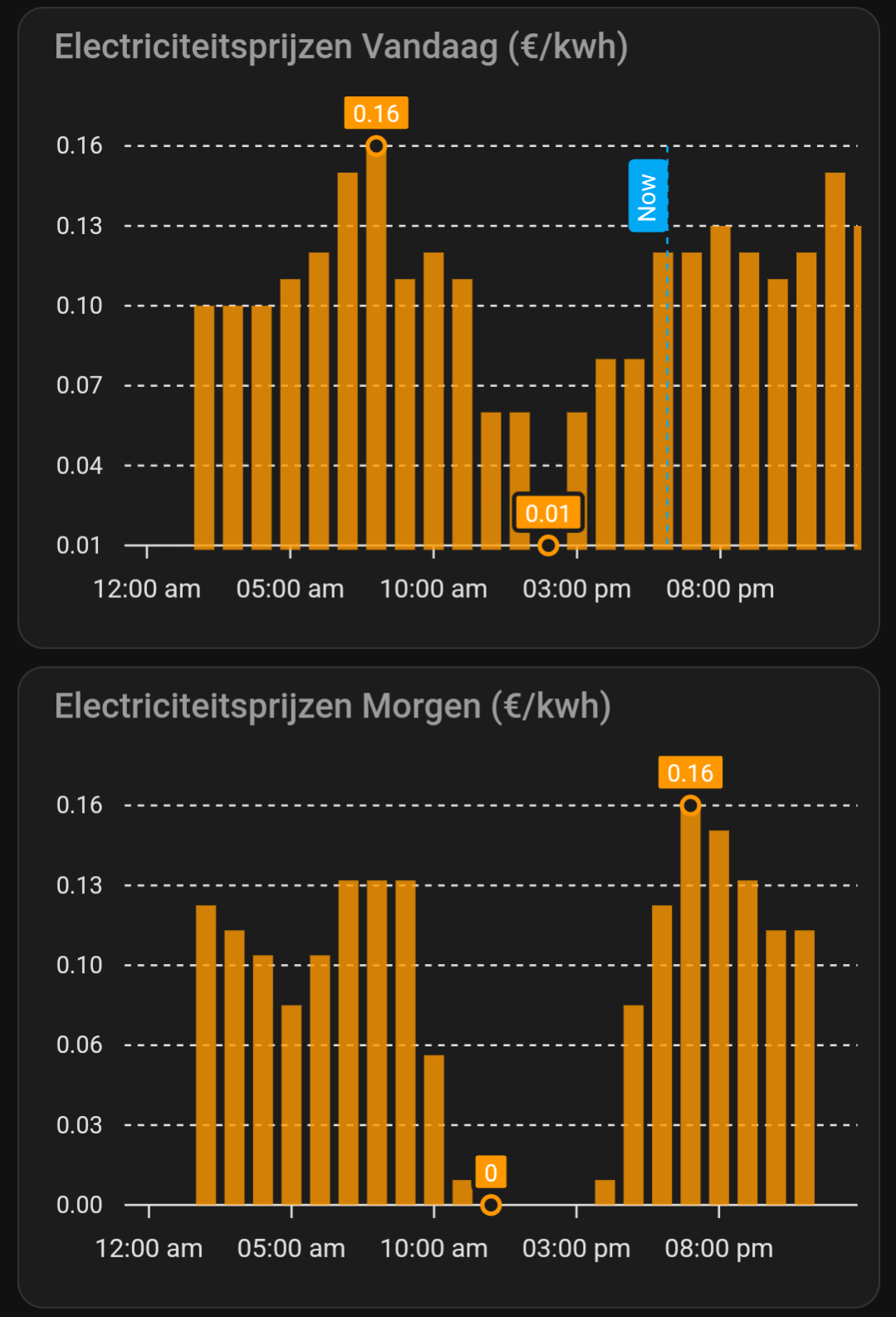
Dynamic pricing contract. Planning when to charge the car, running dishwasher etc is small effort.
Adding 5KW solar panels and a change of contract, from >€500 to something like €75. Family of 4, pretty heavy usage.
Is this exclusive or inclusive of the energy tax? IIRC that’s about €0.15/kWh in the Netherlands
Inclusive tax, but exclusive service fee, handling fee, network fee, administrative fee, etc. You get the picture.
We are getting screwed by the energy companies and the infrastructure companies. Everyone wants a piece of the pie.
At least (some of us) are getting money back, when your solar production exceeds your consumption. But that is going to change soon.
At least (some of us) are getting money back, when your solar production exceeds your consumption. But that is going to change soon.
The same thing is happening in the US. Solar panels used to be a lot more expensive to install, but the amount many utilities would pay your for excess generation was also a lot higher.
I’m also PGE and it’s the same, about $0.50 per kWhr. I don’t even have AC, but I’m typically paying $150-$250 per month.
My AC was set at 84 and I still got a 400+ bill. Its insane. I thought at first my AC was having issues, but the guy came out and its only pulling around 3kw and its definitely working. Found out im using around the same KWH as last year (actually a bit less) but the rate hikes means we see more peaks and much higher bills.
Is it a home you own or rental? Apartment?
If it’s a single family home you should seriously consider the pricey upgrades to insulation. It could cut hundreds off your bill.
But it could also be a better investment to get solar panels in that case.
It has new insulation but thanks.
I live in Washington state, most of my electricity is from hydro or nuclear. My bill is usually about $80 a month, but it can go over $100 in the summer if I’m running the AC a lot.
Average 0.16 USD per kwh if I divide the whole bill by the KWH.
Our bill is pretty high but literally everything runs on electricity in the house, the cooking, water heating, A/C, we have clothes washer & dryer, there is no gas line.
deleted by creator
A $400 bill at $0.50 per kwh is 800 kwh. Our electricity usage in the month of August was 787 kwh. I wired an energy meter into my circuit panel a month ago, so I can break that down:
- 210 kwh for EV charging. I don’t drive a ton and can also charge at work sometimes. This is 27% of our total
- 130 kwh for AC. We live in SE MI, so it’s not hot. We keep our AC set to 75 when it’s on. These two combined are now 40% of our bill
- 62 kwh for my work desk (hybrid work) and deep freeze
- 61 kwh for our furnace blower motor. This one surprised me. We were leaving it on the low setting to equalize temperature. On the low speed it pulls 500 watts, or 12 kwh/day. It obviously pulls more power when the AC is on
- 61 kwh for our fridge
- 28 kwh for our washing machine and gas dryer
- now we’re in odds and ends territory. 17 kwh for our instant Hot water (tea), 12 kwh for our sump pump and dehumidifier, 11 for our dishwasher, 8 for the TV (old fluorescent)/garage/ps5/modem/route, 7 for the microwave
- another 100 or so that doesn’t have a clamp on the breaker
If you don’t have an EV and you’re really keeping your AC at 84 I strongly suspect you have a failing appliance. Unless you live in Phoenix and have a massive and very poorly insulated house or something.
During covid (I was doing remote work, so basically no EV charging), our old dishwasher finally stopped working with a dryer heater error code. When we replaced it our electric bill fell by a double digit percentage (I want to say 20%+) year over year.
As for things like insulation, going from 3" of 1969 insulation to a massive quantity of blown in helped our winter heating bill (gas) a lot more than our summer AC bill.
Good luck!
Sorry to ask, why’re you equalizing temperature?
i feel the AC goes on when it’s hot or warm and the blast furnace goes on when it’s cold, is there a particular advantage as to why you’re doing it this way?
It was mostly for our younger kids. We live in a smaller ranch, so we close their doors after they’re asleep so we don’t have to worry about waking them up. This made one of their rooms a bit warmer In the summer and a bit cooler in the winter.
I should probably try balancing the ducts to compensate and might do that this winter.
How did you get the breakdown? We have a really old panel and may be looking at getting a new one in the next year. Would love to be able to see the breakdowns and figure out where it’s going. FWIW, in PG&E territory.
Look up “home energy monitor”. They install inside your panel. The one we have has a bunch of current clamps, but not enough for our huge panel, so I chose what I thought our more heavily used circuits were. It also measures line voltage. Voltage x current = bingo. I’m not completely sure how I feel about the one I bought, so I’m not going to call it out. I wish it flagged trends per circuit over time to catch things like failing appliances. I could root it and mod it, but it would be nice if it did it out of the box. Catching a failing appliance would more than pay for the device, even if you do it by hand by simply tracking the data. It has slightly changed our habits (see: the furnace blower that we left on all the time and was pulling a constant 500 watts aka 12 kwh/day aka 360 kwh/mo), but I wouldn’t expect to find anything crazy unless you have high usage.
Thanks! Looks like lots of options out there.
Our power panel is old and we’ve been advised it may need replacing. I briefly looked at Span panels, with built-in energy monitoring, but they’re not cheap. These monitors look like you at least get the data at a much more reasonable price.
Thanks! Phoenix is close to our weather, although this week is not a good example thank God. Its regularly over 110 most days of the summer. I have one of the watt meters + a raspberry pi that monitors our watts in real time and can tell what appliances take up the most power. The vast majority of the bill is the AC. In winter, we sip power. Our gas is actually more then.
I’m currently pulling 218 watts right now (fridge/2 laptops/small server/two pis/2 meshtastic devices/one light/ and a host of zombie power devices) and will pull a little over 3kw when the AC is on. And with the tier based system that PGE has, it means months where you do actually use the ac, they jack up the price at the worst possible times. Its closer to 60c per kilowatt hour before fees. And its going up again this year for the 4rth time…
If the biggest portion of your bill is AC and you live in a hot area the only things I could think of are planting some trees if they’ll grow and using a programmable thermostat to shift your usage away from off peek as best you can.
Yep that’s an excellent idea.
There’s also solar ac’s that have started to catch on. I’m taking a look but they seem too new so I’m waiting a bit.
The rate around here is now down to $0.22/kWh. We were occasionally getting electricity bills around $400/month at worst, but we haven’t had an electrical bill since April of this year with our solar panels on the roof now.
I see why you would want solar panels! That’s a pretty high rate.
The rate isn’t too bad actually, but when your household is a larger consumer anyway and you’re charging 2 EVs consumption gets up there. We have also switched to an induction stove, heat pump water heater, added a heat pump dryer, and just recently had our gas furnace ripped out and a cold climate heat pump put in for the HVAC.
With all of that the electricity usage the bill goes up, but we can wipe it out with solar and now we don’t have natural gas bills or gasoline costs for transportation. The up front costs can be high with this approach, but the monthly bills are nearly non-existent.
$0.11 Canadian/kWh, my usage is about 150kWh per person per month, but I don’t have summer AC. There’s a higher rate beyond a threshold of 675kW/h but that’s still under 15 cents. With a zero-use daily charge including municipal levies about 30 cents per day, and some fluctuations based on power sold, imported and other costs (my last bill had like $3 in credits). All in all about CA$25/mo ($18US).
Charged by BCHydro, the provincial power regulator. I’ve been really shocked at how cheap utilities are overall in BC, I budgeted about 3 times the amount I needed when I first moved.
It varies a lot, can be as low as $110 and as much as $170. And that’s just me, a single dude in a small one bedroom apartment. It was half that just a few years ago. So painful.
100-250 per month
Spot on for me in the Midwest. My range and AC are electric, heating is a boiler. So it’s super cheap in Winter and rough in Summer.
$0.50 per kWh is absurd. Where we are, the power company charges $0.1065 on peak and $0.1001 off. (As in, about a dime.)
Note that this is still about 33% more than at the start of the pandemic. We were around $0.07 per kWh prior to 2021.
in bc we have two tier pricing, the first X kilowatthours per month is I think 0.08CAD (~0.05USD), the second is 0.15CAD (~0.11USD)
Our power mostly comes from hydroelectric dams, but we wheel and deal it interprovincially so within the course of a day we’ll spend some time importing and some time exporting which gives us lower rates, and lets other places run more efficiently (ie Fewer gas turbines)
In Malaysia they break it down into tariff so the more you use, your bill will spike exponentially. The rate are RM0.218/kwh for the first 200kwh, then RM0.334/kwh for 201-300kwh, then RM0.516/kwh for 301-600kwh, then RM0.546/kwh for 601-900kwh, then RM0.571/kwh for 901kwh onward.
Factoring in all the other fees that are tacked on, mine is $0.21/kWh in OK.
I’m paying $0.12/kwh base rate but then there’s a 10% additional fee added on to support solar in my area so 13.2.
From late March to early October my monthly electricity bill is something like $89, from late October until early March my monthly bill is like $129 thanks to heating expenses.
2600 ft home in Washington State.
Any of you who are paying more than 20 cents a kilowatt hour, especially if you live in a warmer area of the country, are doing yourselves a grave disservice by not buying and installing a hybrid water heater.
They are fairly spendy, oftentimes costing $1,600 or more just for the water heater and then another thousand or two to have it installed, but heating your water is one of the largest most inescapable bills that you have and a hybrid water heater does double duty by taking the heat out of your air that you are paying to condition and putting it into your water that you were paying to heat, saving money on both at the same time by being more efficient.
If you encounter a scenario where you have $2,500 to spare on a project that will decrease your monthly bills and pay for itself, that’s the one to pick, especially if you are a diy’er and are not afraid of doing a little bit of PEX work.
My electricity cost me 13.2 cents a kilowatt hour and installing an 80 gallon hybrid water heater to replace the 55 gallon that I had took $20 a month off of my power bill.
I did it myself with a little bit of help from a friend and it took me roughly an entire Saturday.
Total cost out the door was about $1,600 because I got a $500 credit from my power company to get it installed, and the water heater cost $1,600, the parts and pieces I needed cost me another $250, and I slipped my friend 250 bucks for helping out.
At an average of $20 a month power saved that water heater will pay for itself in a little under 7 years, which is a good while yes, but if you’re paying 50 cents a kilowatt hour it would pay for itself in under 2 years, and if you live in a warmer climate than Washington State the extra air conditioning it provides free of charge will further decrease your energy bills especially in the summer.
I will also note that the water heater I had was 20 years old at the time and well due for a replacement, making some of this 1600 expenditure an actual necessity and not just a thriftiness move.
Take that into consideration when you are taking my advice.
Water heaters are also stupidly easy to install.
For some reason, in my locale you have to apply for a permit to replace a water heater. I strongly suspect the compliance rate with this asinine scheme is very near to zero. (For anyone reading this, yes, I will totally pay the state for the privilege of installing my own water heater in my own home when I switch mine to hybrid. Scout’s honor.)
Close to the same for me here in Seattle, but my husband doesn’t turn lights off (seriously–ever), so our bill is always a bit higher than yours.
Costco has smart switches from feit electric, it’s a fairly simple install that should only take you a few hours to do six or seven of them.
Then anytime you want you can turn off all of those lights from your phone.
You can also upgrade all of your bulbs to led.
If you’re paying roughly the same as I am, every watt you cut annually saves you about a dollar.
I appreciate the recommendation. We are gradually transitioning all of our lights on to Google Assistant because we have already had that for a little while. About a third of our lights are on it, and we have tentative plans to put the rest on it. So that will help a lot.