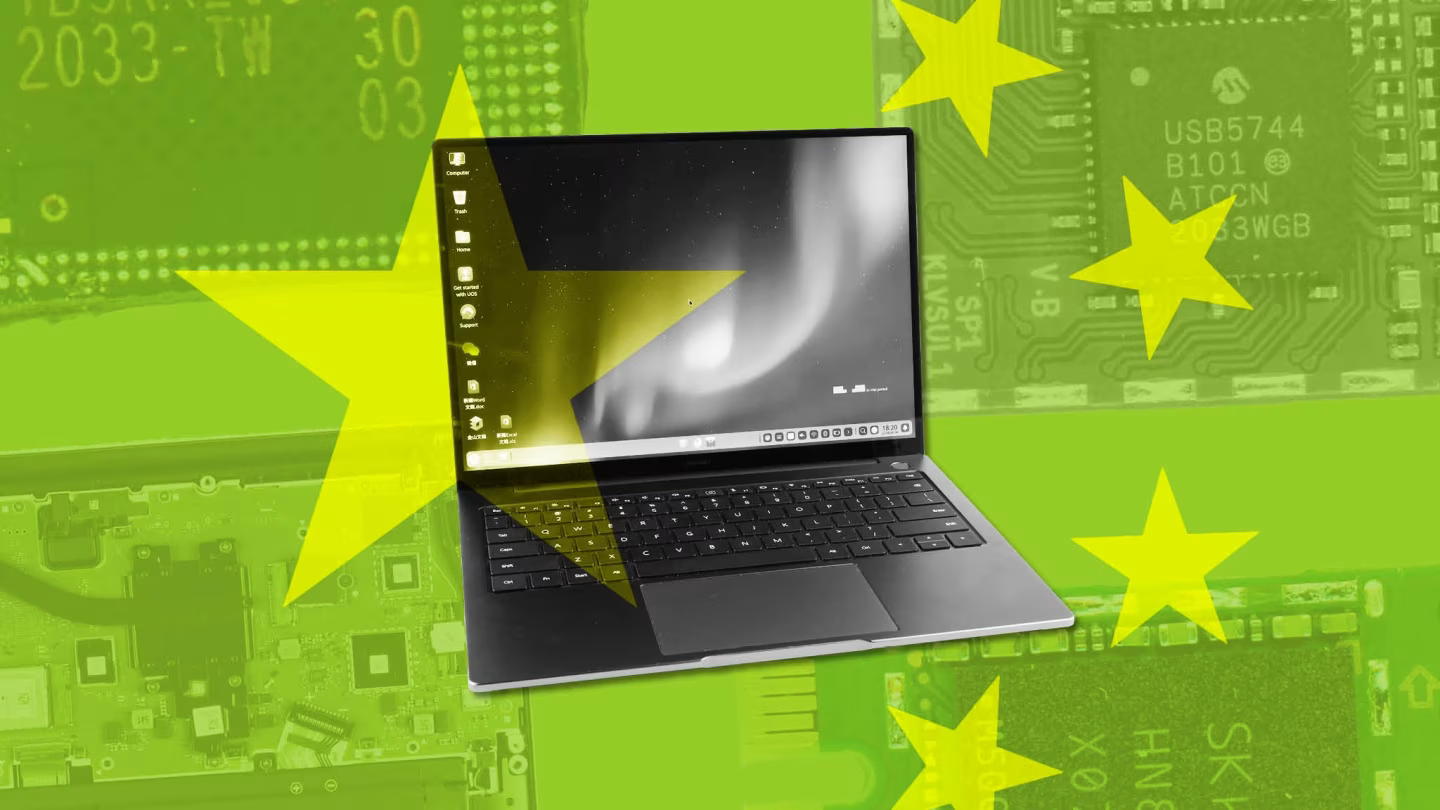
China’s demand that the public sector step up use of domestic semiconductors can best be seen within Huawei’s Qingyun L540 laptop.
The “safe and reliable” device features a self-designed processor and a Chinese-made operating system, having stripped out foreign-made components and software as much as possible.
The computer, which is being snapped up by governments and state groups across the country, has become the signature model of China’s localization campaign known as Xinchuang, or “IT application innovation.”
Tech Self sufficiency? On the hardware level, it will take a while. In the software level, I don’t think it will ever happen. Yes, the desktop and software suite they use, and the distro they’re packaged in are Chinese, But…
the Linux Kernel, the GNU stuff, the systemd stuff, the Freedesktop specifications, Xorg if they still use it, wayland protocols and wlroots, are all developed by people from The West, so if they really want independence, I want to see them replicating all that work from millions of people across the last 30-40 years.
Huawei contribute quite a bit to the linux kernel, it’s a pretty international effort.
Just the first statistics I could find showed they contributed more changesets than any other organisation https://lwn.net/Articles/915435/
Oh shit. Nobody tell congress or else they’re gonna ban linux
Why the fuck would they need to replicate free software? It’s open. Anyone can start doing their own thing with it, independent of external influence.
deleted by creator
Yeah, I like how they call their Debian based distro a “Chinese-made operating system”.
On the hardware level, it will take a while. In the software level, I don’t think it will ever happen.
I’m no computer engineer, but this seems like a silly take. Hardware requires supply chains and some of the most closely guarded technology in the world. Software requires programmers and time.
the Linux Kernel, the GNU stuff, the systemd stuff, the Freedesktop specifications, Xorg if they still use it, wayland protocols and wlroots, are all developed by people from The West,
Literally anyone can download those things and fork them. And I wouldn’t be surprised if there’s already chinese contributors. And if China really wanted, they could even ignore the GPL and not publish their changes to the source code 😲
Not everyone can download extreme UV lithography.
Or they just fork and stop sharing source code. Self-sufficiency would just mean not having to depend on any future contributions. Nobody can stop them from having access to all the old stuff.
Why would they have to replicate this work given that it’s all open source?
deleted by creator
I’m no lawyer. I don’t know if GNU/Linux is subject to the U.S export regulations.
It has nothing to do with the US, so presumably, no.
IANAL, but current case law indicates source code is considered protected speech https://en.wikipedia.org/wiki/Bernstein_v._United_States
I assumed that Linux was not really under the control of the US, but I guess the Foundation is incoporated in the US as a 501©(6) and the kernel org itself is a 501©(3), so that does give Congress more levers on the kernel than I expected.
Not to mention that most (all?) of the major corporate funders of the kernel are US-based…
I really hope the kernel doesnt get (geo)politicized.
Edit: based on @RobotToaster’s link, yeah it looks like every major “employer” contributor to the kernel other than Huawei, Linaro, Arm, and Suse are American. Arm is probably working mostly on support for its architecture, so I guess it’s Linaro (UK) and Suse(DE).
That’s not to downplay the role of independent contributors, but it seems like a good indicator of the “power of the purse strings”.
Edit 2: here’s a more recent set of development statistics from LWN. Looks like the ordering has changed quite a bit since 2022, or it varies a lot with each kernel version
They have a looooong way ahead.
Not really given that they’re only a generation or two behind. People thought it would take a decade for China to get where they are now which only took a couple of years in practice.
In terms of cutting edge chip production they’re well behind - think lithography.
Except that they’re not https://archive.is/NrC6B
Interesting, but for the time being lets call it vaporware. It’ll be really interesting if they actually make it work.
There’s no reason why they can’t make it work, and as the article explains it’s simpler to make it work than ASML machines. The main complexity there comes from the fact that they need to be compact so ASML can ship them around the world. It’s also always easier to do somethings that’s been done before because you know which path to take. A lot of the difficulty of doing something for the firs time is that you inevitably have a lot of false starts while settling on a workable approach.
This is simply a matter of China allocating resources to the project till it works, and they have a lot of incentive to make it work. The only question is how long it will take, and given how rapidly China has been advancing in tech, I would bet it’ll be much faster than people in the west anticipate.
Let’s see, it’ll certainly be an interesting development in any scenario.
and?
And that means the death of western chip industry in the near future. China used to account for around 40% of sales for US chip makers. Losing 40% of the existing market is an existential threat to survival of any company. On top of that, once China ramps up its domestic industry it will start competing with western companies on the global market which will cut their revenue even further. We already saw how the west is utterly unable to keep up with China with stuff like solar cell production and EVs, chips are next.
redstaros is better