
- cross-posted to:
- beekeeping@mander.xyz
- science@mander.xyz
- cross-posted to:
- beekeeping@mander.xyz
- science@mander.xyz
You must log in or # to comment.
Sterols. Lipids found in pollen. Specifically, yeast enriched with sterols.
Doing great work. Thanks.
And of course! Sterols! What I’ve been saying all along!
carols, what I’ve been singing all along
Casseroles, what I’ve been eating all along
Florals, indeed! The shirts I always wear when I’m ready to attract some bees.
Heralds, they’ve carried my commands all along
Well this story is the bee’s needs!
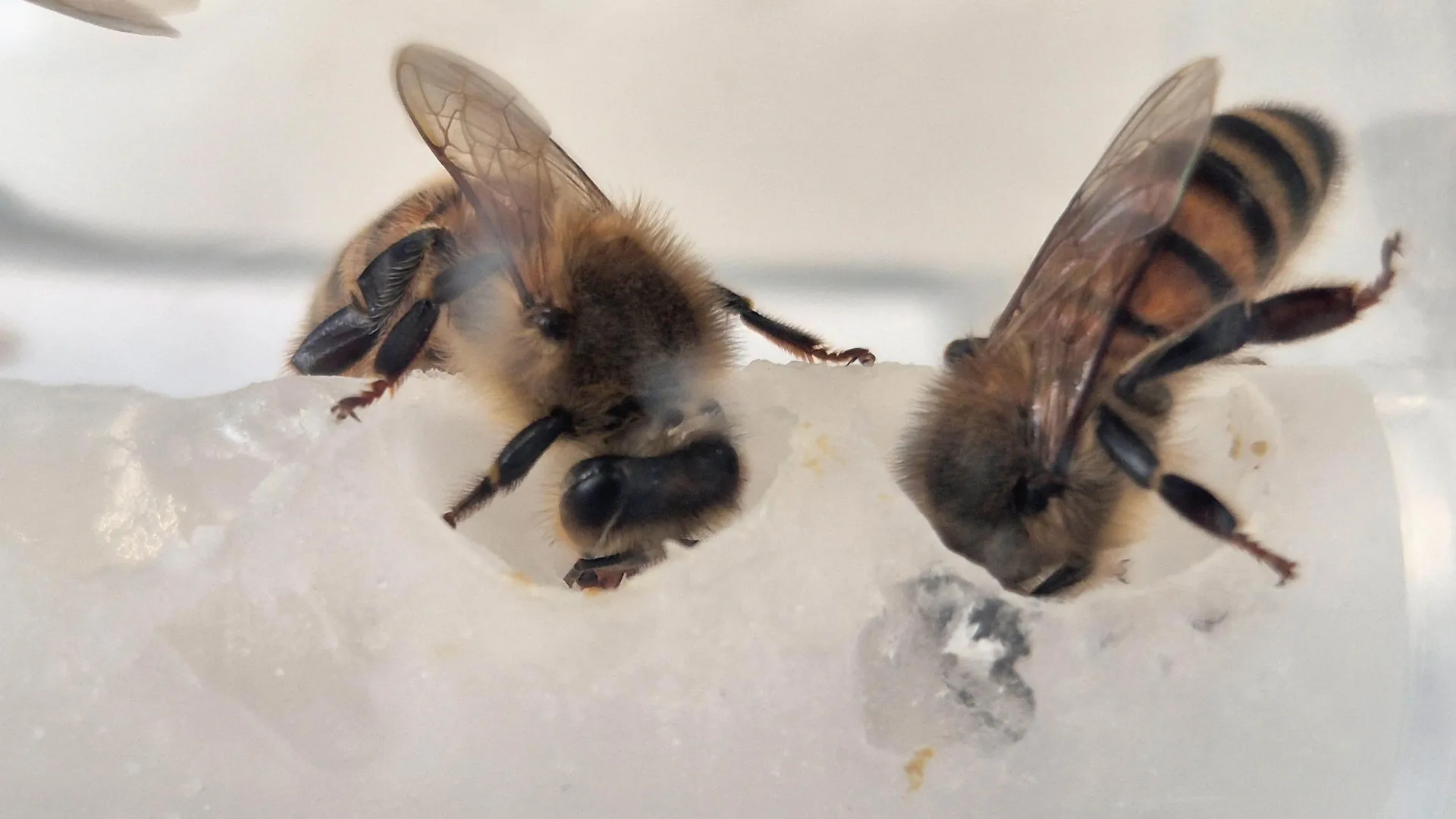
Colonies fed with the enriched diet were more likely to continue rearing brood up to the end of the three-month period, whereas colonies on sterol-deficient diets ceased brood production after 90 days.
Uhh m not crazy right, that’s the same thing?
I’m with you, it’s confusing. But I think what it means is this:
The study ran for 90 days. Non-sterol bees had stopped doing bee sex by then. Sterol bees were doin it all the way up to the end of the 90 days - and then the study ended. We can therefore assume they wanted to continue having freaky beedsm sex for even longer.
I could begrudgingly accept that, if that’s what is it was
Some were observed brooding for up to 12 weeks!
Amateurs, I’ve been brooding for years!
I laughed. Thank you
Gotta be AI bullshit. But I’m reading it as, group A never stopped while group B stopped breeding at the end of the period.
Why in hell is poorly written text “AI bullshit” now? An LLM would probably write that in a clearer way.
Were articles irreprehensibly written up to 3 years ago?
Fuckin old men of Restelo!
For me it’s because the study is dated August 2025. Everything after November 2022 is suspect.
one group continued to the end of the study period, the other group had stopped by the same time
or, one group stopped doing a thing, and the other group didn’t show signs of stopping

TL;DR: They found six sterols found in pollen could be produced from engineered yeast and increased brood production dramatically. The article talks about them as essential nutrients but is it possible they are signaling molecules affecting bee behavior?
Your second sentence is your own thoughts, not part of the tldr summary, right? I think you should make that separation clear (in Wikipedia terms, I’m flagging this as “original research”).
Yes, it was. I could add a paragraph break by editing.
But I won’t.
Sterols are steroids
True. Sterols are a subset of steroids. I guess my question was what is the important function of those sterols in promoting progeny production?
Pretty sure you misread the article, it said pierogi production.
also important
This is why bees are so important to our food supply.
“Oh, so we can kill 15 times more before it becomes an issue” - Monsanto, probably
And then goes on to kill 30 times more.
Allow native wild flowers and plants to grow and get rid of the damn grass.
I am expecting the Trump Regime to take this miracle and use it to raise Murder Hornet colonies or something.
Genetically engineered to be attracted to minorities and immigrants
Fun facts: “killer bees” are also known as “africanized bees”. In the 1970s there was great alarm in the US about the spread of africanized bee strains because they’re so much more aggressive than European bees. There was even a terrible horror movie about it, but this particular catastrophe never materialized. I had a friend in graduate school in the '90s who was part of a team of scientists investigating the problem. It turns out that if you raise an africanized queen in a temperate climate, the bees she produces are no more aggressive than European bees; likewise, a European queen raised in a hot, tropical climate produces bees just as hyper-aggressive as typical africanized bees. So the entire thing was just bee racism all along. Bracism?
Of course global heating is going to make this a bigger problem everywhere, but fortunately we’ll be fucked a lot worse by all the other problems this is going to produce.
Really? This is super interesting. I have been stressing out about when the swarms of murder bees reach me here in the north still in 2020s and you are telling me this is one of the few things I didn’t need to worry about…
deleted by creator

No, I was definitely thinking about bees so…
Yay, new anxiety!
Nope, they’re just reacting to old news
And I also never heard that it was bracism all along. I always wondered why that faded from public consciousness
Which is scariest? Particularly brutal hornets or swarms of aggressive bees? One bad sting or uncountable stings?
deleted by creator
deleted by creator
deleted by creator
Adricanized honey bee scare came back in the 2000s, didn’t it?
Anyway, we know the adricanized honey bees were a myth, but adricanized honey badgers are a real force to be reckoned with
deleted by creator
deleted by creator
Oh, Trump will definitely cook up some “emergency” as an excuse to stay in power.
Stop giving him ideas.
Rfj jr will ban the substance for being synthetic and not a natural remedy
And issue an executive order renaming the European Honey Bee to the American Honey Bee.
Shhhh don’t tell them about Italian bees. I want to start a hive when I buy a place. If they know about them they’ll surely try to kill them off somehow
Bigly bees. The best.
Um, isn’t this like majorly good news? Like maybe among our most important discoveries?
Good for bee keepers, but most plants are pollinated by wild bees. So this could help, but doesn’t really change much in the grand scheme.
The whole “save the bees” thing is about wild bees, not domesticated ones I think
deleted by creator
This isn’t true. Colony collapse disorder has been a big problem for beekeepers.
Though interesting they’ve been staving it off rather directly; you have millions of colonies die, but you can breed millions more per year to keep the population stable. It is more expensive, and a bit dark for the bees.
Nobel Prize in all categories.
Yes. Very good news.
deleted by creator
It’s the bees needs.
It has what bees crave!!
This is the most uplifting science article I’ve read in a while. The process they describe in the article sounds long and involved with many dependent steps. Great work!
Until you realize that wild bees and insects won’t receive that food but the cause of their detriment won’t be adjusted because we now have enough bees to pollinate the fruits on the farms.
I do love native plants and I will deeply mourn the mass extinction of the Anthropocene. You’re not wrong.
But I was choosing the bright side here. It’s a lovely contrast to the destruction of NASA, the NSF, and all the trickle down effects in the science world. This bee work is delightfully from the UK and will be harder to cancel. It will help agriculture keep up with exponential human growth amid climate change and water overuse for slightly longer than it would last otherwise. I’m deeply pessimistic, but the bee thing is a little hopeful, ok?
very ok
deleted by creator
As I wrote in response to the not really view, I’m deeply pessimistic about the future, and the hope that I appreciate here is only for slightly extending agricultural yields so that I can keep eating cheap food for a few more years. Overall, we’re all fucked. I guess I’m not allowed to celebrate one bright spot in the enclosing darkness, thanks.
deleted by creator
There’s nothing bad whatsoever about a breakthrough discovery allowing for essentially nutritionally-complete synthetic pollen. It’s all positive, full stop. The negatives you want to emphasize are that it doesn’t also solve other related problems. I never said that it did, only that it was the most uplifting science story in a long time. I read the whole dammed article, not just the headline, and I was very happy to have it get into a lot of details.
Feel free to have your middling reaction without celebration. I’m excited to have a positive science story I can discuss with my kids, and I’m sticking to that.
deleted by creator
Source on positive headlines decreasing care and activism?
I see the opposite. Everyone believes systems can no longer solve any problems, and have checked out.
I thought that honeybees were the last bees that we should be saving since they harm native bee populations, which are move vulnerable.
The European honeybee in the Americas is kinda a double edged sword. It’s an invasive species, which both steals resources from and spreads diseases to native bees. However, for better or worse at this point a good portion of agriculture is dependent upon the European honey bee.
… And they produce honey, which I like.
Capitalism. I should have known. Thanks for the context!
It’s a little more complicated than that, honey bees are great generalists and there have been a lot of winners among North American plants. But yeah, “capitalism” isn’t far off the mark.
…how do you arrive at Capitalism from “a good portion of our agriculture”?
Simple. A good portion of our agriculture is based on capitalism. Prior to the industrial revolution (capitalism) there weren’t nation sized monoculture farms full of identical genetic freakshow plants.
Because agriculture itself isn’t a problem. Rampant (and unnecessary) exploitation, to satiate artificial scarcity is.
Because as we all know, socialists don’t need food.
It’s probably useful for other types of bees too.
I thought the reason they die was pollution. I’m confused at why some new nutrient would save them.
There’s a lot of problems bees (both honey bee and native bees) are facing. There’s varroa mite, a virus spread by mites, pesticides, pollution, habitat loss, monoculture… a lot of stuff. However, healthy bees are more resilient, so healthy hive is much more likely to shrug off a event that could be “the straw that broke the camels back” for a weakened malnourished hive.
subscribe to more bee facts!
(long as you leave seinfeld out of this)
They die for a variety of reasons, including disease, pollution, heat waves, etc. Not being half starved of essential nutrients means that they’re more resilient.
From the article:
[Unaffiliated expert] said: “[…] bees face many stressors. Good nutrition is one way to improve their resilience to these threats, and in landscapes with dwindling natural forage for bees, a more complete diet supplement could be a game changer. This breakthrough discovery of key phytonutrients that, when included in feed supplements, allow sustained honey bee brood rearing has immense potential to improve outcomes for colony survival, and in turn the beekeeping businesses we rely on for our food production.”
I expect there are dozens of different things that influence how well a hive does, some good, some bad. Maybe having better nutrition overpowers the effect of pesticides, varroa mites, etc.
Hope they can get it to mass production. I have some bees in the area and would love to help the little guys.
QUICK. What flowers produce pollen high in Sterol.