Artist: Albrecht Dürer
Year: 1502
Medium: Watercolour and bodycolour on paper
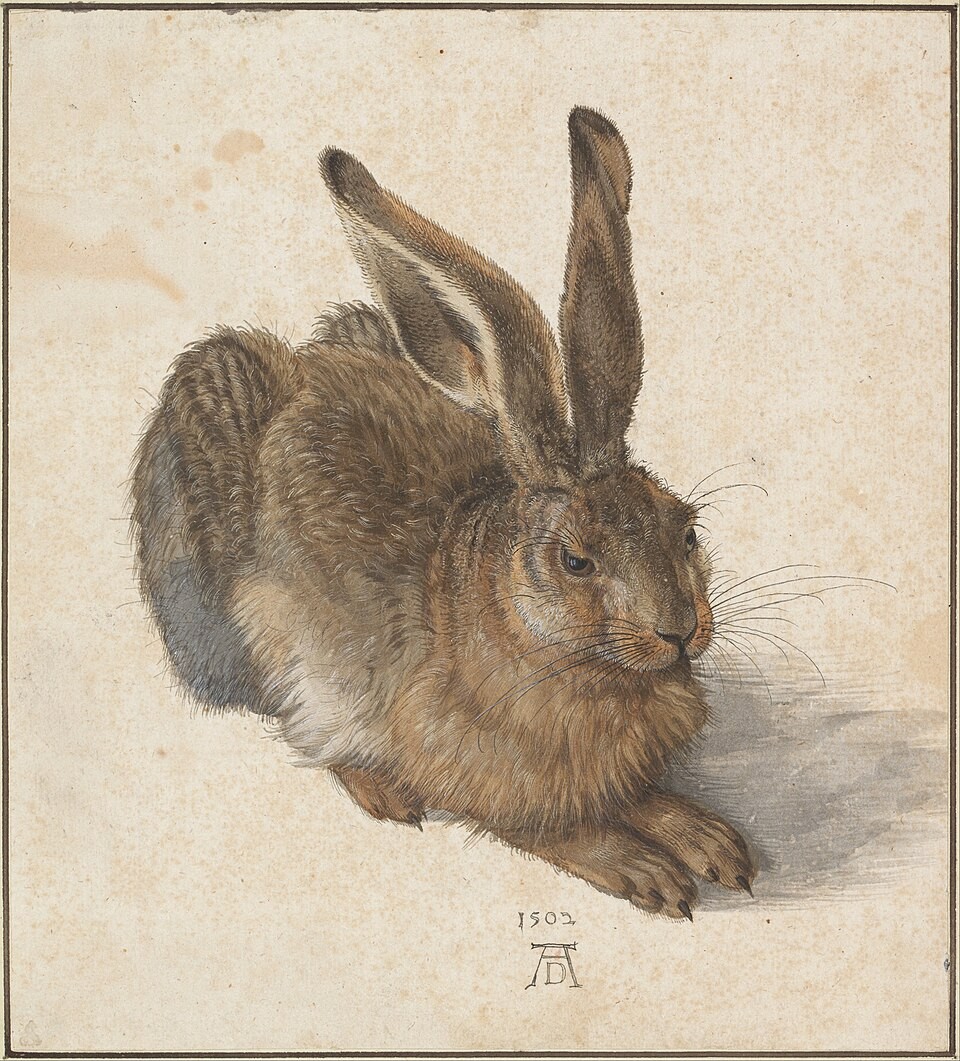
Young Hare (German: Feldhase) is a 1502 watercolour and bodycolour painting by the German artist Albrecht Dürer. Although the piece is normally given the title Young Hare, the physical characteristics of the hare identify it as a mature specimen; the German title translates as “Field Hare” and the work is sometimes referred to in English as the Hare or Wild Hare.
Painted in 1502 in his workshop in Nuremberg, Germany, it is acknowledged as a masterpiece of observational art alongside his Great Piece of Turf from the following year. The subject is rendered with almost photographic accuracy.
The work remained in Dürer’s workshop until his death in 1528. The work was then sold to Willibald Imhoff, to whom it belonged until 1588, when Imhoff sold it to Emperor Rudolf II due to financial difficulties: In 1691, the work made its final move to the Albertina Museum in Vienna, where it is still held.
Do you think, when Duerer and his contemporaries introduced perspective into painting, people natively understood and just saw it or did they first have to snap their eyes to it, like some optical illusion. Like, if you show someone a 2D projection of a cube for the first time, will they immediately be: “Yeah, that’s a cube” or will they have to train their eyes on it? Kinda like this Mary’s Room thing, in which they tested whether people born blind could distinguish a cube vs sphere visually after having their vision restored, by transferring qualities like “round” vs “edgy” between senses (they can’t). shower thoughts
I’ve always found that an interesting question.
I think people back then must have been amazed by pictures like this and probably had to get used to what they were seeing at first. I suppose they must have perceived a certain magic in them that had a quality quite unique to itself.
I mean, even much later, philosophers such as Walter Benjamin (1892–1940) wondered whether a work of art might lose some of its “aura” in the age of its technical reproducibility—that strange magic that makes art so powerful for the viewer and also seems to depend on the context in which it is viewed, whether as a copy of the artwork in another medium or simply in an era when there are other ways to capture reality.
“That’s a great Rabbit, Albrecht. I wonder if you could do us a picture of a rhinoceros?”
“Great, now just checking, you’ve seen a rhinoceros before, haven’t you?”
Verily, good sir, I prithee, there thou hast it.
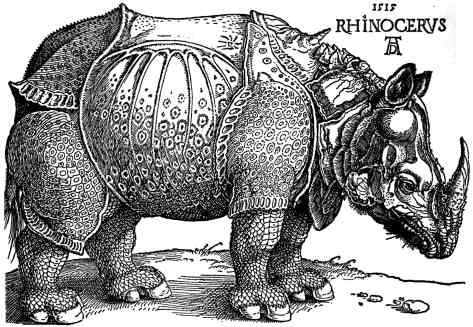
“Brilliant. I’ve never seen one myself, so I’m going to assume this is 100% accurate. I’ll have 10 copies, please”