Most of the former nations can at least offset this with immigration, while the latter ones don’t
I have heard Asia is the racism final boss continent.
racism is just that guy standing in front of the real final boss in Asia: xenofobia
In humanity. Some people exclude others because of the order in which they apply spreads to scones, some because they disagree about whether the bread they’re eating is literally or metaphorically a man’s body, and some because they like a different sports team.
Oh yeah China doesn’t have enough people it’s a huuge problem
Ok, but what happens when you have 500 million retirees that have to be supported by 300 million workers that are also trying to feed and house themselves and their children?
What are the numbers like now?
Korea actually has a lot of migration of Koreans from China and Western Asia. It is actually a pretty unique situation. The Chinese Koreans already speak Korean and their culture align perfectly with Korea.
It’s in all ways a better situation than western countries. But no, let’s pretend that Asia is collapsing. Better than fixing issues in the west.
Countries that take immigrants vs countries that don’t:
.8 birth rate is going to be a huge problem for South Korea in a few years. The rest are just “oh no, capitalism’s infinite growth will be finite after all”
Lower birthrates are less an issue that people think.
For any living being self replication can explode incredibly fast, and it’s usually the case when numbers dwindle, due more resources available per person.
Big birth numbers are more worrying and limited resources lead to fast “too little resources for everyone” situation.
I remember reading that part of what took Europe our of the dark ages after the black plague was that survivors thrived in an post plague environment. Also remember reading that dutch population growth actually taller because after so many people died survivors got more meat and food in general available to them, so their children grew a lot.
So in general I’m always more worry about high birthrates than low birthrates.
This was true back when the economy was vague and vibes based and people kind of just died and it was ok. But now we have pensions, and it’s considered unacceptable for people to starve to death and economies to collapse, so an upside down pyramid starts to get wobbly rather than “self-resolving”.
Can you elaborate? Why 0.8 in South Korea is so much worse than 1.08 in Poland?
The growth (or in this case decline) is exponential. 1.08 is bad, 0.80 is terrifying. 1.08 is roughly half of the fertility needed for a stable population (about 2.1 children per woman). This means that per generation your population shrinks by half its size. 0.8 is another 25% lower. At an exponential rate these differences add up fast. The first one gives you (roughly) one child per 8 great grandparents. The other one needs 18. So over 3 generations the population shrinks by another factor of more than a half.
Wait, is the chart ”births per person” or ”per woman”? I was reading it as per person, so 1.08 per person would be about 2.16 per woman.
Edit: probably per woman. Lines up better with https://data.worldbank.org/indicator/SP.DYN.TFRT.IN?locations=JP . Grumble grumble numbers without units.
Grumble grumble numbers without units.
You and both, buddy. Grumble!
But the birthrates are still falling everywhere. Countries that are at 1.08 today will be at 0.8 soon. I think they are just hitting the problem sooner, not that they are facing a different issue.
Here’s a visualization of the birth rates of Japan, Poland and Germany against those of South Korea:
https://georank.org/birth-rate/japan/south-korea
https://georank.org/birth-rate/poland/south-korea
https://georank.org/birth-rate/germany/south-koreaJapan and Poland have been stable, maybe slightly declining, since the early 2000s, and Germany has been stable for 50, all below replacement, whereas South Korea is still going down.
I am no demographic expert, so take this with a grain of salt, but for the moment it doesn’t look like the other countries are going to hit the same problems at the same severity anytime soon whereas South Korea is going to get hit by the full force of their demographic issues within a few short decades.
Japan and Poland have been stable, maybe slightly declining, since the early 2000s
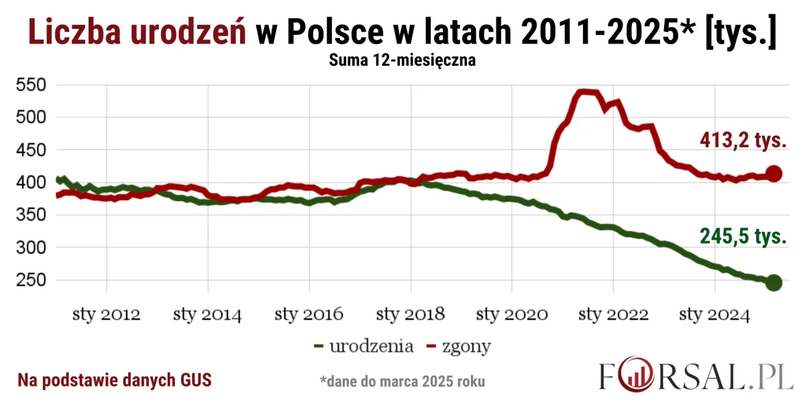
I just checked Poland and it’s not what they are reporting:
Number of births:
Birthrate:
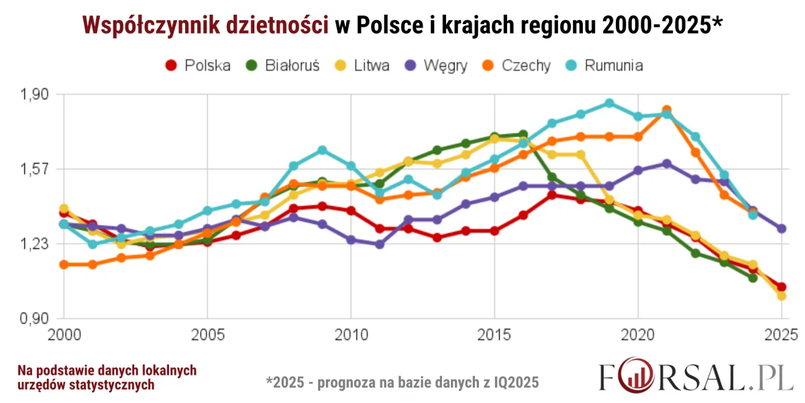
Systematically falling for the last 10 years. Yes, it was better before that but experts say it doesn’t look like stopping anytime soon. But I guess we’ll see.
Those are data from GUS, the official statistics bureau of Poland.
Far from comprehensive, but a good primer.
The problem is similar to climate change. The effects of today will ripple several decades into the future, and people everywhere are more short-sighted than they would like to think, you and me included. Our brains are built for hunter gatherer lifestyles, sensing urgency in actions that will come back to us in 40-50 years just isn’t how we are programmed. Germany is already entering the danger zone, the effects won’t be stark for another 30 years or so perhaps, but if we delay much then there will be nothing to do to counterbalance it effectively. Demographic collapse is an issue that is way past mitigating by the time it becomes an acute problem. An ounce of prevention is not a pound or even a ton of cure, it’s the only cure. And when it starts to hit noticeably, that means you are just going over the side of the waterfall and it’s going to get a lot worse before it gets better. Korea is just starting to tip over the edge of the waterfall, in 5-10 years it is going to get much worse.
The takeaway from the meme isn’t that we are overreacting to their situation, it’s that we are underreacting everywhere else. The real insidious issue is that in most nations having this problem, society largely panders to its politically active and (comparitively) wealthy elder base, and the best way to boost the birth rate is to shift support from them towards the young, which is politically problematic. So we are stuck in a situation where those with power have to act against their interest, in order to avoid problems that will happen far later than our brains are hardwired to care about. In short, the prognosis is very bad. Imho, the only chance most western nations have is watching things get very ugly for the elderly in Asia, and using that to scare their constituents enough to convince them that short term sacrifice is needed to avoid similar conditions for themselves. But I’d say it’s a long shot.
I am truly convinced after seeing line go down.
Westerners just REALLY want wealthy, peaceful Asian countries to be uniquely awful.
There’s way too many people on Earth already.
That’s capitalism speak. There’s way to many resources in the hands of the 0.1%. Should their wealth be redistributed you’d have everyone’s needs met
Both can be true.
I don’t advocate for any sort of culling, but we might want to aim for sustained population instead of infinite growth
That’s not birth rates, that’s fertility rate. One measures births/1k and the other is an average of births per woman on their “child bearing lapse”.
Japan might have a fertility rate of 1.2 but they have 6 births/1000 people. Argentina with 1.5 have 11.1 births/1000
A more relevant measure is “Natural change”, it measure people death vs people birth not counting immigration:
India has +13 millions. Japan has -870k. China has -2 millions.
South Korea is “only” losing -77k people per year.
There are like 30~ countries that have negative population per year out of 197. Birthrates and fertility rate are going down each year, but not every country is losing population by it.
Source: https://georank.org/birth-rate
China should go extinct alright
Let’s start with russia, that will free up a lot of land for neighbouring countries
I highly doubt that the birthrate in Italy is 1.14
The government and the media doesn’t stop yapping about how it’s declining and we are going extinct.
This happens of course for economical reasons, and the government comes up with the most half assed “solutions” to ever cross human mind. Like “reduce VAT taxes on diapers and powder milk” like that is gonna make any difference.
It happens because women have more choice over when and how many children to have.
That’s why you see it still falling in countries that have good economic and social safety nets.
I won’t cry in less argentinians, au contraire, fodam-se os bolhudos