- 13 Posts
- 177 Comments

 2·2 days ago
Drawing some arbitrary line between energy sources and ‘power amplifiers’ is a distinction without a practical difference.
So if you were talking about a car, there is no difference between the volume of the fuel tank and the horsepower of the engine? ;)
The whole point of this article is that people are totally muddled up about the distinction. The title starts 'power, not energy… '.
With all due respect, his point is made clear by your comment.
Also, the word he uses is ‘exergy’. You said ‘Energy’. I’m not clear you followed the logic.
Why don’t you state what you think the argument is and what’s wrong with it? Are you just bashing the writing style or do you have a genuine disagreement with the idea?
“I don’t like it” isn’t the same thing as “he’s wrong” or “I disagree”.
Invest in popcorn.

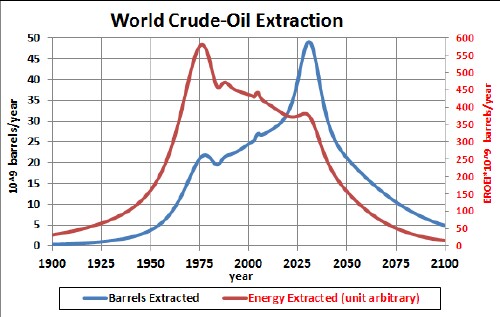
Barrels extracted is still on a steady growth slope, but the total net energy (per year, year over year) is declining anyhow.
I think the energy cost of the barrels is eating into the energy profits. We don’t seem to be growing the volume as fast as we need to, as the quality is going down.
We seem to be in this point in time where oil production is keeping about the same, but the net energy for the world is dropping.
On some level we have many frontiers where there is a devil’s bargain to keep things stable and slow roll change…
I suspect that this is partly political and social engineering: so that normal people don’t notice the problems in any kind of shock and there is no psychological moment where people collectively recognize the change and react en masse.
This is a somewhat masterful policy of softening shocks into continuities. This is the opposite tack to the Shock Doctrine, where it prevents the advantage of a recognizable moment for political change (de-leveraging it instead of amplifying the opportunity). Obviously each issue you smuggle past the public consciousness is very fleeting in effect, but you can build a Potemkin Village reality if you persist over time.
At least, that’s the point that I feel might be missing from this article’s analysis. The facts of the strategic reserve sale are pretty obvious, but I don’t think this is designed to prop up the economy, it’s and confuse the public awareness of the change.
= = =
Old school disinformation was to take a truth and make one counter truth and sell it hard.
New school disinformation is to take a trurh, make 8 theories all with criticisms of the other theories, spread every single one at the same time and allow this to fracture consensus reality. It takes time for this to fully rupture the public idea-space.
I hate to say this, but this has already been obvious.
I think a lot of pro-climate environmentalists originally had a two step program:
-
Slow down the rate of new pollution so that secondary feedbacks don’t kick into gear.
-
Before the slow moving changes kick in, REVERSE climate forcing and get rid of the CO2
After decades, themessaging got repeated and amplified and eventually the popular understanding turned into this:
-
We need to get down to net zero emissions eventually.
-
Celebrate victory, that’s everything.
This second thing mistakes the target of zero emissions as the end goal and lost the greater context. Bafflingly, this is by and large the mainstream environmentalist view and its just completely unsupported by any real science.
Wrong, wrong, wrong. We have like 5 years left to start reversing forcing and obviously climate causing pollution is still increasing at an annual rate. And we have to actually go BELOW the original CO2 level to get climate to respond, because the system has hysteresis. Like there is a huge gulf in understanding that has opened up.
A lot of environmentalists believe that we already have all the technical solutions and if only billionaires, oil companies and governments would act, we could solve this calamity. Super naive.
To believe that, you have to believe plan #2 is real. If you believe we need to do plan #1, its extremely apparent we have NO FREAKING CLUE how to fix the climate problem. Things are not under control and humans are not what’s preventing this from happening, we have a fundamental failure in our ability to respond in any meaningful way. We are not going to get anywhere without first contending with a realistic solution space that’s at the true scale of this issue.
This division in peoples’ understanding makes half the environmentalists sound like climate deniers. People who don’t thinks EVs and solar panels add up to a plan #1 solution are ignored by the mainstream view that #2 is what we are all supposed to be talking about.
Science education is a huge part of the problem, a lot of people are just kind of scientifically illiterate…
I should now add this: A lot of scientists are now saying this:
Because we failed so far, we should do this:
- Stop CO2, get to net zero.
- Do geo- engineering to temporarily pause secondary feedbacks so that we have more time
- Remove carbon from the atmosphere.
^ the geoengineering allows the carbon removal to happen before the earth systems start moving, so that the amount of carbon you need to remove doesn’t increase too much…
( I fully expect this to morph into the idea that geoengineering is a full solution and will make a livable climate and that we don’t need to go further and reduce carbon. )
AGAIN, removal of the carbon is what needs to happen to make a survivable future. But try stating this in environment circles and you’ll be ignored and criticized…it’s just politically unpalatable.
-
Some of the established demonstration permaculture farms feed one person on 5 acres. (The upper limit might be 4 acres in some locations.)
There are about 22.5 B acres of land on earth available for cultivation and agriculture.
That could feed about 2.5 B people if everything is totally optimal. This would be no draft animals, no digging, no tilling, like a giant designed food system that needs less energy to maintain, more passively regenerated.
Its not that different of a carrying capacity, I’m just tossing this out there as an alternative approach to the calculation.
Basically let’s get rid of 500 million draft animals and have humans instead.
 1·15 days ago
" Paul Walter Hauser currently has an offer on the table for a fascinating role in Netflix’s upcoming live-action Scooby-Doo series: Scooby’s original owner. "
Scooby’s back story is finally getting unmasked?
Sorry, I’m never watching this. I even thought Scrappy sucked back in the day.
Peak oil is also peak food.
People have looked at the numbers here for what fertilizer contributes:
https://ourworldindata.org/how-many-people-does-synthetic-fertilizer-feed
A ballpark estimate is that around 40% of all food comes from the fossil fertilizers. This is derived from tracing the nitrogen in food proteins back to the source inputs.
Of course, you can also go through the carbon side of the food chain and there are lots of energies being spent throughout the system…
We are currently exceeding the planetary boundary for nitrogen, about 63% of our fertilizer use would need to go down in order to preserve the global ecosystem. The fertilizers are so excessive that they are killing the natural ecosystems.
https://www.nature.com/articles/s41586-022-05158-2
Excessive agricultural nitrogen use causes environmental problems globally, to an extent that it has been suggested that a safe planetary boundary has been exceeded
Its hard to see how we can use only 1/3 of the fertilizer rates and still make enough food.
Last time I looked the fertilizers were consuming only around 4% of annual global methane production, so 'peak oil ’ will hit for tractors, combines, refrigerated storage, transportation and other aspects (diesel fuel, electrical power) before we don’t have enough methane to make fertilizers.
 1·16 days ago
THIS is why we need green energy, fossil fuel infrastructure is far too brittle.
There is actually a report that does a deep dive into some of these details:
https://www.iea.org/reports/energy-technology-perspectives-2024
Warning, this is a svelte 400-page report!
I was mentioning this because of the content of Chapter 5 & 6.
In summary, in Chapter 5 the case is made that the global supply chains for the renewables economy require an order of magnitude more shipping because most of the resources are very material intensive. For example, we will need much more dry bulk ocean freighters to transport ore, metals, coal and so on.
In Chapter 6 on the strategic considerations, it turns out that multiple new shipping lane chokepoints will be created, many of them in socially unstable and dangerous areas. In some of these areas huge ships will be passing through 100s of times a day. The location of these chokepoints shifts dramatically from the fossil fuel paradigm.
The report concludes that the “just in time” fossil fuel markets are more susceptible to short term disturbances, but the post-carbon economy will be vastly more reliant on massive massive transport supply chains with lots of lower density materials. Where already installed energy systems are not disturbed in the short term, the supply chain will be exponentially more vulnerable to shocks and there are much larger attack surfaces.
The report analyses 10 marine shipping chokepoints starting at page 385. In the charts that follow, you can see how a lot of petro shipping passes through one or more chokepoints, but the cleantech will have 3X more chance of the shipping supply chain passing through chokepoints. Solar, EVs, batteries and heat pumps are the tech that is particularly vulnerable to passing through these chokepoints.
Whenever a shipping lane is disrupted, ships have to take longer journeys to bypass the issues, and longer voyage times has the same effect as reducing the total amount of ships available globally. It also raises costs and creates domino effects in supply chains.
In summary, the cleantech economy is a massive increase in supply chain complexity. I really don’t think most people understand how much low density material will need to be moved around the globe in the future. Cleantech is a much more intense global industrial supply chain.
I have a MAGA acquaintance and I saw him today, and he still can’t stop talking about Epstein. I don’t think the distraction is working.

 2·19 days ago
Assuming the stem is aluminum, and the steerer is steel?
Heat up with a torch. Soak it from the bottom using ammonia. Repeat for 2-3 days.
You can also just cut it out or drill it out.
That’s because the whole theory is wrong.
The renewables/EVs are being made in factories that are a long term investment in coal powered manufacturing. They are being shipped in oil powered ships and driven by diesel trucks on asphalt roads and mounted on concrete foundations or whatever.
The entire supply chain is the exact same supply chain that was designed in the fossil fuel era.
The renewable energy system is less than 3% of the whole thing and the system isn’t being redesigned.
Unfortunately, what we were doing was always childish and superficial.

“The adults in the room for the last 30 to 40 years have been deeply childish on climate change.”
… what I am saying is replay Fallout New Vegas, Hardcore mode, just in case.
I just ordered a case of Nuka-Cola.
Pretty interesting scorecard.
If I’m not completely mistaken, the way they have approached the “tipping points” is as if everything is logically an independent variable.
It seems as if they don’t consider that tipping a system can cascade into changes in other systems. Where is the positive feedback / runaway / correlation consideration?
Example: if the sub polar gyre slows and greenland melts, should the AMOC be just as likely to tip under 2° than if the gyre didnt slow and greenland didn’t melt and its 2° of warming?
Temperature alone cannot be the only large contributing causal factor?
So a specific thought is that they say the Boreal is susceptible to abrupt shifts and couple to permafrost melting. Much of the scientific literature treats this as if it will be a gradual source of carbon released over centuries, but for example this study implies that 40% of the carbon coming out of the thaw is ACTUALLY released to the atmosphere in the first decade. This paper says that the 3M sq km of permafrost melt at the start of the Holocene injected more carbon into the atmosphere than all the industrial sources (so far).
 7·1 month ago
One of the best “all style” movies has to be:
“The Good, The Bad and the Ugly.”


That’s exactly what he is saying. Renewables deliver power to the grid.
What he is saying is that at the same time they provide power, they don’t deliver energy (if you do all the accounting for the system).
This doesn’t laud fossil fuels. This is only a critique on renewables if fossil fuel use is a negative. He is saying that renewables (right now) are a scam for being not enough of real solution to the problem of fossil fuels.
Do not mistake being qualified on using renewables as pro-fossil fuels. The author is actually saying renewables aren’t automatically anti-fossil fuels and we are doing them wrong. He’s calling for a clear minded adult conversation and not childish oversimplifications. As far as I can tell, he’s saying this can’t work if we don’t get rid of “grid” systems entirely. We need a totally different system.
The problem is that people are fooling themselves about what is going on, really.