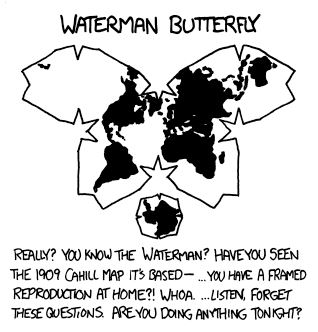
Not only is NZ on this map but it’s not even way off in the corner!
I’m happy for NZ but it might be a good idea to stay hidden for the time being.
We need a maps without nz Lemmy house
Front and center!
-ish!
We drawing maps for 2000 years now experience pays out. :D
Can someone smarter than me explain why South America is seemingly immune to hurricanes?
I also want to know this.
https://www.ncesc.com/geographic-pedia/why-do-hurricanes-not-hit-south-america/
According to this, TL;DR- South America is further from the swirling warm winds of the topics than it looks, and the ocean temperatures are colder compared to the hurricane prone areas too due to how the oceanic currents work.
Rainy season in Northern Africa has a lot of land to form storms from sand as cloud seeds. Gulf and Carribean sea are almost always hot in summer. Relatively shallow. Northern South America also has rainy season and helps form storms that go north.
South America doesn’t get as much help from Africa storm formation, and south atlantic does not have a history of being very hot.
The Coriolis Force | https://www.youtube.com/watch?v=_36MiCUS1ro
I think a better question is why are the northern hemisphere hurricanes so much more feathery and beautiful than those raggedy ass southern hemisphere hurricanes and tropical storms.
Because there are way more in the northern hemisphere I assume ? Probably due to greater differential between water and air temp in general in the northern hemisphere due to currents and shit
Indeed!
Im certain that’s because of tornado related physics and things. 👍
I’m guessing it’s because they rotate in different direction in the northern and Southern hemisphere.
So crossing would imply switching direction, which would require to put that energy “somewhere” and it’s physically not possible.
really interesting. what’s the reason why?
Stole explanation from r/ELI5:
When you stand on the north pole how fast are you moving relative to the earth’s core?
Zero, you just spin around in place once every 24 hours.
When you stand on the equator how fast are you moving?
1000mph, you have to circumnavigate the earth in a day.
This difference doesn’t matter much when you throw a baseball, but it absolutely matters when you’re a storm the size of a country. > This disparity in relative speed rotates the storm since the equatorial side is moving faster than the polar side, and it provides the swirling structure of the hurricane.
But here’s the problem - storms in the north spin counter-clockwise and storms in the south spin clockwise.
That means to cross the equator you have to stop and reverse direction. That’s not happening, and hurricanes never track near the equator because neither the storm itself nor the prevailing winds that push it around can approach this reversal boundary.
The equator itself is associated with very low wind speeds, aka the doldrums.
Ah, the calm belt.
Probably Coriolis effect? I’m not a professional meteorologist but I am an amateur meteorologist. I live in New Orleans and hurricanes follow somewhat predictable patterns. (Maybe not always where you can pinpoint exactly where they’re going but they tend to turn north in the northern hemisphere and south in the southern hemisphere.)
You can also look at some of the coastlines and see the millions of years of erosion from the same patterns once the continents moved more into what we have now.
If you’ve ever heard of sailors talking about ‘the doldrums’ the calm bit is the doldrums.
I’m going to say the Coriolis effect but… I don’t know?
Oh man, I didn’t realize that Oman got hit by tropical storms.
it’s wild to think that we here in the nordics are apparently less safe from them than people in most of africa are!
Interesting that the western Pacific seems to have so many more category 5 than the Atlantic, and while the South Pacific and Indian Ocean have plenty, the South Atlantic has basically none.
🎶ECUADOR! 🎶
Philippines truly drew the short straw here
Getting hammered.
Massive if true.
Huh, it looks like the hurricanes seem to move in a mostly east-west direction.
That’s because when they cross the equator they become cyclones
Atlantic Ocean = Hurricane Pacific Ocean = Typhoon Indian Ocean = Cyclone
A yo mama joke that only works with this context:
Yo momma’s ass so fat, no hurricane dares to cross her ass crack.
The form above 10^* lattitude. Their natural direction is to go straight towards their respective poles, but high pressure systems steer them with the trade winds. Extremely rare for a storm to even go slightly towards the equator