Title text:
‘This HAZMAT container contains radioactive material with activity of one becquerel.’ ‘So, like, a single banana slice?’
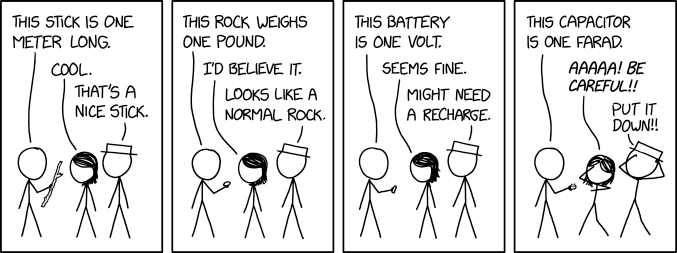
Transcript:
[Cueball holds a stick while talking with Megan and White Hat.]
Cueball: This stick is one meter long.
Megan: Cool.
White Hat: That’s a nice stick.[Cueball holds a smallish rock.]
Cueball: This rock weighs one pound.
Megan: I’d believe it.
White Hat: Looks like a normal rock.[Cueball holds a small battery.]
Cueball: This battery is one volt.
Megan: Seems fine.
White Hat: Might need a recharge.[Cueball holds a capacitor while Megan and White Hat panic.]
Cueball: This capacitor is one farad.
Megan: Aaaaa! Be careful!!
White Hat: Put it down!!
Source: https://xkcd.com/3106/
I used to teach AP physics to kids on the weekends. One asked me why Farads were so big. I had to explain that there’s a fixed ratio between Farads, Volts, and Joules. One of them had to be crazy big or crazy small.
See also Coulombs.
Caps are especially scary because they can develop their own charge through static electricity, so large value caps are often shipped with their terminals tied together.
There’s nothing in the SI system that says ratios have to be between base units. Units that involve mass are defined against the kilogram not the gram.
The kilogram is just a thousand grams, so if they’re tied together, they would still be tied together.
Right. 1F = 1C/1V … they could have just as easily said 1kF = 1C/1V. Many things use kg instead of g. You can tie together things other than the unscaled base units. Then they are still tied together but 1F is a more reasonable amount.
But kilogram is the base unit
Of the SI system. The metric system started with cgs (centimeter, gram, second) and evolved from there.
You sent me down a freaking rabbit hole, thanks! :)
From what I found is that there is the simple reason that the weird ones are distance, time and weight - the rest I looked into are based on formal non-normalized definitions (including lumen, which surprised me).
My guess is that in depends on where the unit comes from: science or day to day use.
I learned about the Siemens, the Weber and the Gray on the way.
Thanks again!
They were all done by scientists or engineers.
The meter was defined based on what they calculated as 1 millionth of the length of Paris’ meridian.
The second was 1/86400 of a day, which makes sense with the angle/circle nomenclature on the clock.
The gram was initially set to be the mass of 1cm³ of water at 4°C - which is why 1l of water ≈ 1kg.
The concept of length is way older than these definitions, same for weight and so on.
The meter is an awesome example for what I mean: the 1/1000000 wasn’t random. From my understanding it won over the alternatives in dezimal because of it’s relative closeness to an arms length and the definition was used to remove issues in France because of the (metric) fuckton of different measurements for length.
And the second example of yours is even better describing what I meant: it’s just making sense and is practical not a deep scientific reasoning.
And I won’t bliebe that the foot and inch was conceived by anyone who has a scientific approach.
To be clear: you’re right that basically by definition the units were done by professionals. I try to point out that for the more broader used units practical aspects were at least as important (after all it wasn’t a square meter that was used for the gram but a centi of one).
It’s also the length of a pendulum with a half period of 1 second.
Whaaaaaaasaaaa
I have no idea how I’ve missed that y today I’m over of the lucky 10,000 I assume. Thanks!
“This magnet has one tesla”
That stucks ;-)
It is not that much though. You could easily make an electromagnet with magnetic flux density of multiple tesla in it’s core.
And you can get 1F capacitors in bulk from China for a few dozen dollars each.
Those things are still dangerous and scary. The 1T magnet way more so than the capacitor.
This capacitor will cost around one Bitcoin
We use it to ignite the tokamak.
Actually no, depending on the voltage it costs from 5$ to 100$ Also here’s 5.5v 1f capacitor

Only criticism is the use of non-metric weight units when everything else is SI-based.
Wikipedia currently says:
the international avoirdupois pound, […] is legally* defined as exactly 0.45359237 kilograms
So, technically, a pound is a metric weight, only a niche one whose use may or may not be permitted by local regulations.
Similar is true* of the inch, which is defined as precisely 25.4 millimetres.
* The US, UK and a handful of others collectively signed this into their respective laws in 1959. You might think we don’t use the pound in the UK any more but it still shows up often in informal situations. Ditto inches and feet.
That’s similar to saying “Auf Wiedersehen” translated to English is “until I see you again”, therefore “Auf Wiedersehen” is technically English. Just because there’s a recognised translation to a thing, that doesn’t make it that thing.
It’s not a recognised translation- it’s the definition.
If we’re going to split hairs then while it’s defined in terms of metric units, it doesn’t scale with prefixes and factors of 10, so it can’t be an S.I. unit.
You’re right, the imperial units are not S.I. units, but each (most?) imperial unit is defined by an S.I. unit.
The other way around maybe, that is, an English word becoming technically foreign because we decide that we are going to write its definition in a different language in the dictionary.
It wouldn’t make sense to do that though, which kind of breaks the analogy. Unless you count words borrowed wholesale because we didn’t have that word, and those definitions were written in a foreign language first.
As it is “one pound” now translates exactly to “nought point four five three five nine two three seven kilograms” where it didn’t before 1959. “kilogram” is one of those foreign borrowings.
I would argue that a legally defined conversion to a meter or another metric value does not make a unit metric in and of itself. Those units have to adhere to the system, which is clearly based on decimal values, not just some arbitrary conversion with an absurd precision that was only signed into law to minimize the inconvenience caused by non-standard units.
It’s not a defined conversion, it’s the literal, internationally ratified definition of what those units are. Or maybe “redefinition” ought to be the word there; prior to that definition there were several very similar, roughly equal but ultimately not internationally standardised units in use. And since they were redefined in terms of SI units, they’re technically SI.
This is one of those “tomatoes are technically fruit, but no-one with good sense would put them in a fruit salad” situations.
Guys you’re not gonna believe this:

pfff at 2.7V that aint much of a danger, now show me 50F @ 2kV
Yes, I do not believe it. It must be a misprint, right?
No it’s real! I can’t verify the exact rating since it OL’s my meter, but with some circuitry it can power my Pi for a few minutes. I got them from element14, so it’s unlikely to be a fake product.
Amazing! Thanks for the reply.
However, 1 farad is really goddamn big.
Lol, explainXKCD
Ah, Randall is alive! I kept thinking my bot had broken as it’s so rare for him to miss an upload.
But why pick one pound? The are so many fun units to choose from, only some of which are conveniently sized. How about a stick 1 mile long, or a rock that weights 1 grain?
A rock that weighs one stone (14 lbs).
Or a barleycorn that’s one barleycorn long? Or a really large foot that’s a foot long. Or a chain that’s a chain long?
A chain is 66 feet long.
That’s 2376 barleycorns, or a small bag of grain if you will.
hogshead is my favourite
Imagine what it’s like to calibrate an instrument like that.
I bet it’s kind of going off of the original SI representation where, like, a foot was the length of the king’s foot, and that was what they had to measure against to make sure everything was accurate.
Their names are Cueball, Megan, and White Hat?
I remember reading about their names in explainxkcd. I think the only one never named in the comics is Cueball.
For a while, there was a blog, but I don’t think it named any character.
I’d be the clueless guy in the room. “I’m not familiar with that unit of measurement.”
A capacitor of 1 farad at standard American 120 volts has the energy between 7.62×54 and .50 BMG, and will discharge just as violently.
Great. Now I get to be the “I’m not familiar with that unit of measurement.” guy.
3,291 J (2,427 ft⋅lbf) to 3,400 J (2,508 ft⋅lbf)
The .50 BMG round can produce between 10,000 and 15,000 foot-pounds force (14,000 and 20,000 J), depending on its powder and bullet type, as well as the weapon it is fired from
foot-pounds
Oh, you Americans and your silly made-up units.
All units are made up.
I totally agree that imperial units are silly, though. Base 10 is the way things should be.
But then we’d miss the fun of domain specific units, like A barn
Didn’t even need to translate to foot-pounds-force, since .50 BMG was already in freedom-loving units.
Oh you non-Americans and your lack of wheelchair access ramps.
See how stupid and annoying this is?
So what you’re saying is that if I touched that in the wrong manner I’d get blown across the room?
Uh yeah, I’m pretty sure the discharge can stop your heart if you grab it in precisely wrong manner. Typical defibrillator uses like 50 times less energy, but with a higher voltage.
🚲
this guy gets it.
Thats literally exactly what it is. They aren’t derived from the metric system like all units in the system, theyre a specialized edge case where a conversion was specifically written in because america sucks. There are no other conversions in the metric system, units are derived from constants based on a set of specific rules that the pound and yard do not adhere to.