[2026-06-15] Jeff Kaye's Hidden Histories (Part one, continued in comments)
[

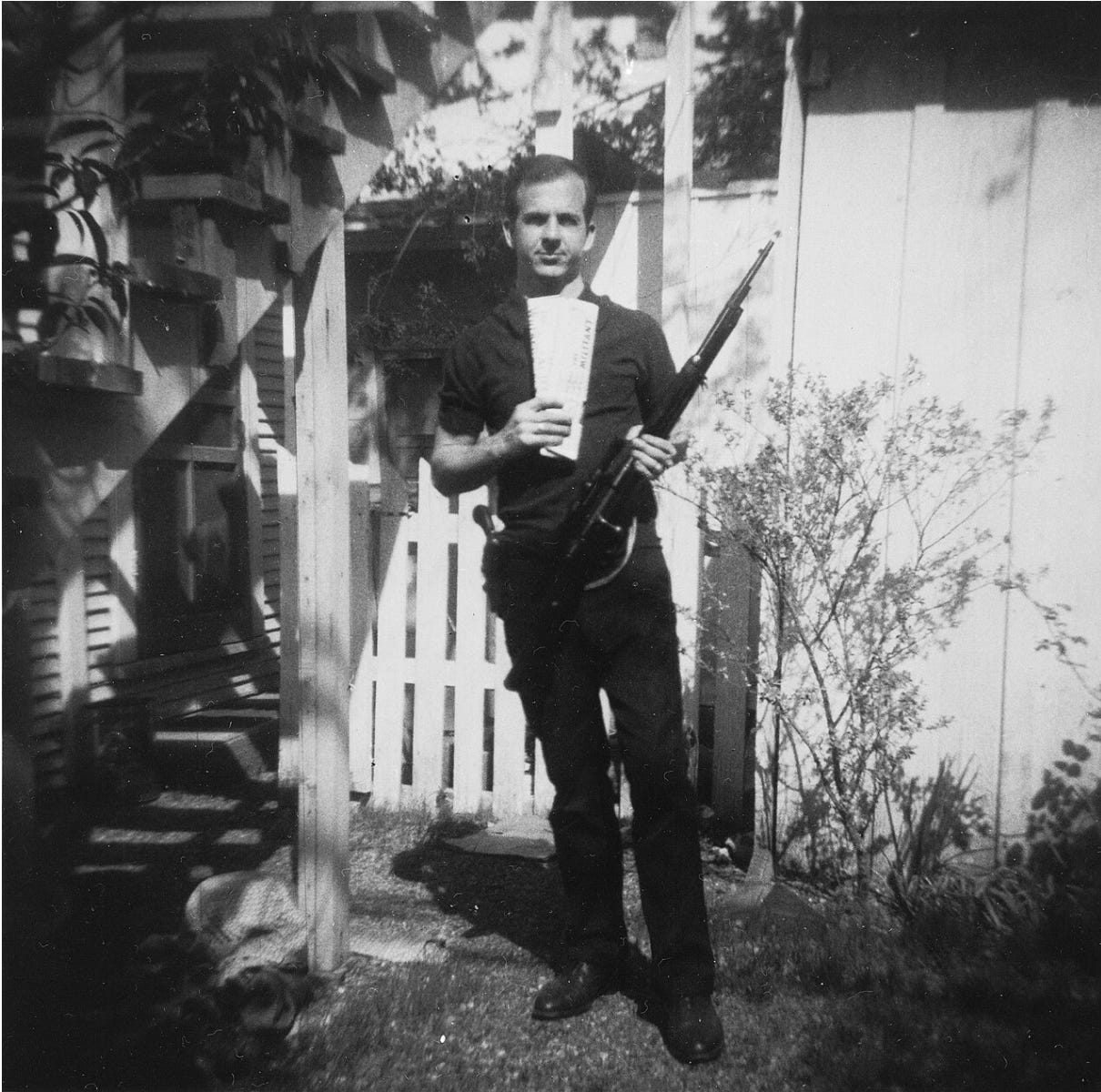
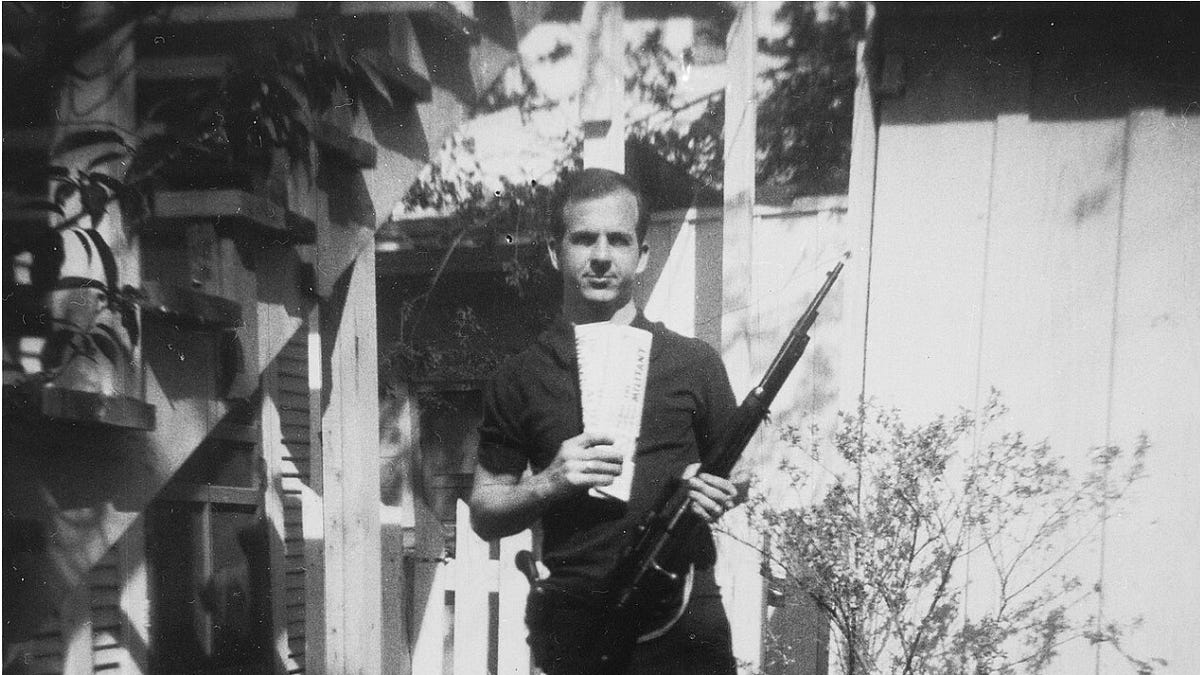
“Lee Harvey Oswald with rifle and pistol in Oswald’s back yard, Neely Street, Dallas, Texas, March 1963.” Author: Marina Oswald. Source: Wikimedia Commons. Public Domain (Note: the provenance of this photo is disputed.)

“Everybody in the intelligence field in this area knew Oswald. And everybody knew Ruby.” — Col. Rudolph M. Reich (Ret.), former Operations Officer of the U.S. Army 112th Intelligence Corps Group in Texas, to Timothy Wray, ARRB, July 24, 1996, pg. 3 (emphasis in original)
This investigation began as a continuation of earlier research into the intelligence community’s involvement in promoting the Warren Commission’s Oswald “lone nut” narrative. There is much to still be discovered about that. When I subsequently pulled on one thread of that story — the links between Life Magazine reporter Donald Dale Jackson and the military intelligence (MI) community — something else was revealed: the presence of key figures in the assassination story with links to military intelligence, and in particular, the U.S. Army’s Counter-Intelligence Corps (CIC). This is a story taken up in part by others,1 but I think most people will find a number of new items in this article.
What kinds of MI presence were there? For instance, the Secret Service cars both immediately in front of and behind John Kennedy’s limo on November 22, 1963 carried former CIC agents, Winston Lawson2 and Clint Hill, respectively. The consul in Moscow who met with Oswald alone on his first visit to the U.S. embassy on October 31, 1959 was former CIA official and military intelligence (G-2) man, Richard Edward Snyder.3
The first federal agent that I was able to determine entered the Texas School Book Depository just after the assassination was James W. Powell, who was “a member of the 112th INTC [Intelligence Corps] Group,” which maintained an office in downtown Dallas, and had been close enough to Dealey Plaza to have heard the assassination gunshots (brackets in original). Powell’s presence opens the door to a long-simmering controversy over the presence or non-presence of local military intelligence officers in Dealey Plaza on the day of the assassination, a controversy that will be addressed later in this article.
According to a 1997 report by Timothy Wray of the Assassination Records Review Board (AARB), the 112th INTC “was directly subordinate to 4th [U.S. continental] Army, and in fact its headquarters was virtually side-by-side with 4th Army’s headquarters at Fort Sam Houston” in San Antonio. The 112th was initially a unit of the Army’s Counter Intelligence Corps, and was “enlarged to a counterintelligence group in 1957. It was renamed the 112th Intelligence Corps Group in 1961, though it went by the cover name ‘4th U.S. Army Operations Group’ until July, 1962. Its official mission was ‘to contribute to the operations of 4th U.S. Army through the detection of treason, sedition, subversive activity, and espionage and sabotage within or directed against the 4th U.S. Army and the area of its jurisdiction” (pg. 3, material in brackets added).
At the time of the assassination of President John Kennedy and the murders of Lee Harvey Oswald and Dallas police officer J.D. Tippet, the 112th INTC Group “had approximately 300 military personnel and 25 civilians assigned to it” (Ibid.). As we shall see, there was notable overlap with Dallas police force personnel. There was also the fact that the army unit was involved in domestic surveillance of civil rights and other political activists.
Returning to examples of military intelligence figures associated with the assassination, there was the mysterious John David Hurt, the man Lee Harvey Oswald tried to reach by phone when he was in custody in the Dallas jail. Hurt, who was disabled and perhaps mentally ill, seemed a strange choice to call, but one thing was clear — he had a background in intelligence as a CIC officer.
[

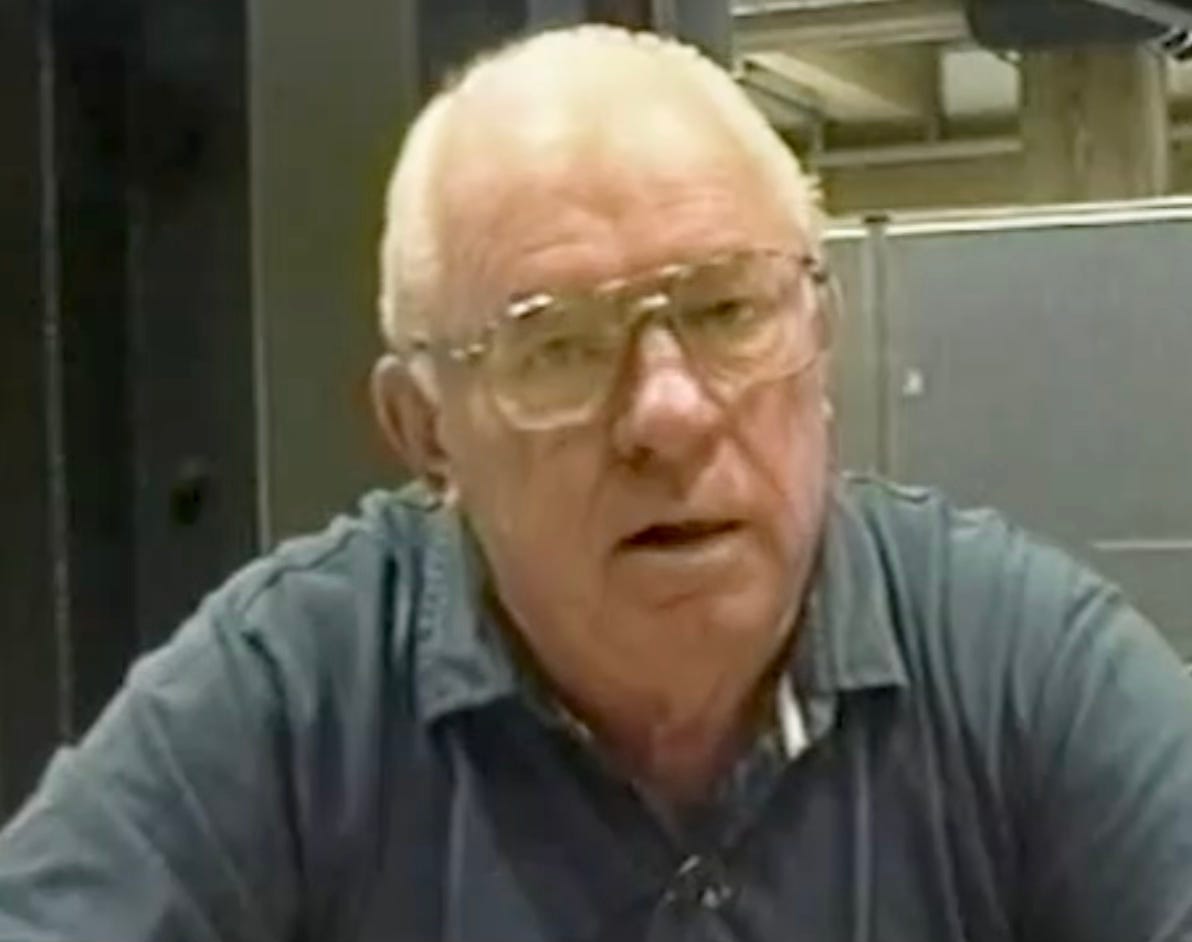
S_creenshot (08:39) from video interview of Joseph Cody, October 1, 1999. Oral History Collection/The Sixth Floor Museum at Dealey Plaza_
The cherry on top of this group was probably Joseph Cody, a Dallas police officer and former CIC agent, who by his own account said he knew Jack Ruby better than anyone else in Dallas (video, see 32:30 time-mark). He also claimed he was the first police official to interview Oswald, even before homicide detectives got a crack at him (26:55). And — what a coincidence is this! — he purchased specifically for Ruby the gun Jack Ruby would later use to shoot Lee Harvey Oswald.
Interestingly, Cody met Ruby approximately ten years before the JFK assassination while Cody was still “on assignment” for CIC, according to his interview with the FBI on December 16, 1963. Cody said he and Ruby bonded over their joint love of ice skating, and that they went ice skating together many times. So far as I can tell, no other source has ever mentioned Ruby’s predilection for ice skating. For some reason, Cody was never interviewed by the Warren Commission. He died in Dallas in 2008.
From Cody’s December 16, 1963 FBI report, which was listed as an exhibit in the Warren Report:
CODY stated he was in the Korean War and was assigned in the Counter Intelligence Corps. He stated that while on that assignment he had been assigned in Dallas part of the time and, during that time, had gone into the Silver Spur, The Carousel, and the Vegas Clubs, on several occasions [all clubs associated with Jack Ruby - JK].
[

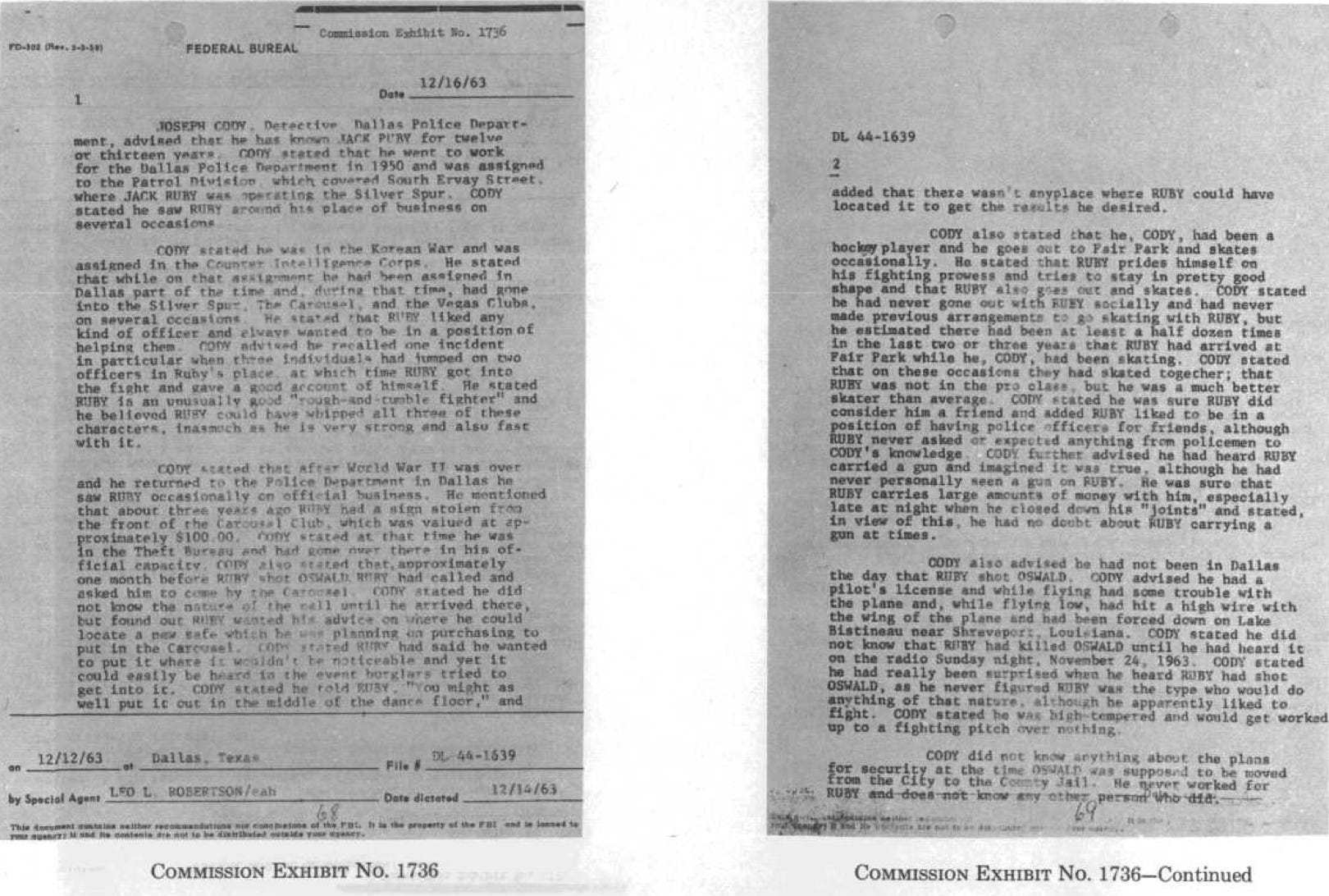
Screenshot of FBI report on interview with Joseph Cody, December 16, 1963. Source: history-matters.com
The FBI report also noted, “CODY stated that after World War II was over and he returned to the Police Department in Dallas he saw RUBY occasionally on official business.” It sure sounds as if Ruby was an informant or some kind of asset for Army intelligence. If Ruby had been an intelligence asset for CIC agent Cody, could their skating rendezvous have been a cover for meetings between an agent and his asset?
In addition, it seems worth mentioning that Jack’s older brother, Sam Ruby, told the Warren Commission that he (Sam) had worked for Army Air Force Intelligence while he was stationed at Langley Field in World War II. Sam indicated that his superiors knew Jack by name, and Sam’s reports were to be signed using a code name, “Johnny Newman,” addressed to his “Dear Brother Jack,” and mailed to “a certain box number in Newport News, Va., which was about 20 miles away from Langley Field….” (pg. 503).
A July 11, 2025 podcast at Fourth Reich Archaeology noted the Sam Ruby connection with Army intelligence and commented, “the fact that Jack Ruby was even as a very young man being used as a foil, as basically a straw man, a front for intelligence operations and psychological operations is another one of these pile of facts that are part of the evidence that stack up a mile high and draw extreme suspicion” (00:18:21 — link to transcript).
In fact, if we add up Sam Ruby, Joe Cody, and the many intelligence-linked officers at the Dallas Police Department (as will be discussed further on), not to mention Ruby’s connection to CIA psychiatrist Louis J. West, and the fact that in 1947 Jack also performed “information functions for the staff” of then Congressman Richard Nixon, Ruby seems surrounded by intelligence figures for much of his adult life.
I should also add Richard Case Nagell to the list of military intelligence figures around Oswald. Nagell had been in the CIC from approximately 1954 to 1959, and joined the CIA a few years later. He claimed to have known Lee Oswald while the latter was stationed in Japan. He also said that he had advance knowledge of the assassination and had been ordered by the KGB, for whom he allegedly was a double agent for the CIA, to warn Oswald about the plot.4
I only mention Nagell here because I think the list would be incomplete without him. However, the Nagell case is so convoluted, opaque, and mysterious that I cannot really link him with the other men listed above. It would take an entire article to sort out the different strands making up his story and take the reader too far afield from the main topics I aim to focus upon.
Finally, there was one other person with military intelligence credentials who claimed to have knowledge of the assassination, former Military Intelligence Service (MIS) agent Gary Underhill, who also worked in some capacity for the CIA. Interestingly, given the topic of the essay here, Underhill also worked as a pictorial journalist for Life Magazine from 1938-1942. After that he joined MIS, “working on technical and photgraphic headings for MIS publications, evaluation of intelligence, and enemy uniforms, insignia, weapons, etc.” According to a 1961 article in Der Spiegel, Underhill “had been employed by CIA as an arms expert during the Korean War” and helped supply “arms to various trouble spots.”
As quoted in a document released only last year under the JFK Records Act, an article in Ramparts Magazine in June 1967 told an incredible story about Underhill:
The day after the assassination, Gary Underhill left Washington in a hurry. Late in the evening he showed up at the home of friends in New Jersey. He was very agitated. A small clique within the CIA was responsible for the assassination, he confided, and he was afraid for his life and probably would have to leave the country. Less than six months later Underhill was found shot to death in his Washington apartment. The coroner ruled it suicide.”
As with Nagell, a full telling of the Underhill story is outside the scope of this article, though that doesn’t mean it isn’t relevant. I’ve included both Underhill and Nagell in this listing of military intelligence figures because both expressed special knowledge of the assassination. If they did know, did their knowledge come from military intelligence contacts? Or from within the CIA itself? Both Nagell and Underhill seemed quite nervous about what they knew about the assassination. Later on in this article, we will meet another military intelligence figure, Stephen Weiss, who also seemed worried about providing investigators information about what he knew about Dallas.
While CIA, CIC, MIS, FBI, etc. were all separate organizations, in practice their personnel would overlap, and they often worked together on assignment. As an example, a 1978 in-house history of the CIA’s Mexico City Station, written or overseen by Anne Goodpasture,5 and released to the House Select Committee on Assassinations, documented close work between the CIA, CIC and FBI. One case in particular called for CIA “to provide surveillance and investigative assets to CIC” (pg. 205 - PDF pg. 72).
As for CIC itself, it was disbanded by the Pentagon in 1961. Its human assets may have been sent here or there, but I assume many or most were sent into the newly created “Army Intelligence and Security Branch” (later renamed U.S. Army Intelligence and Security Command, or INSCOM).
[

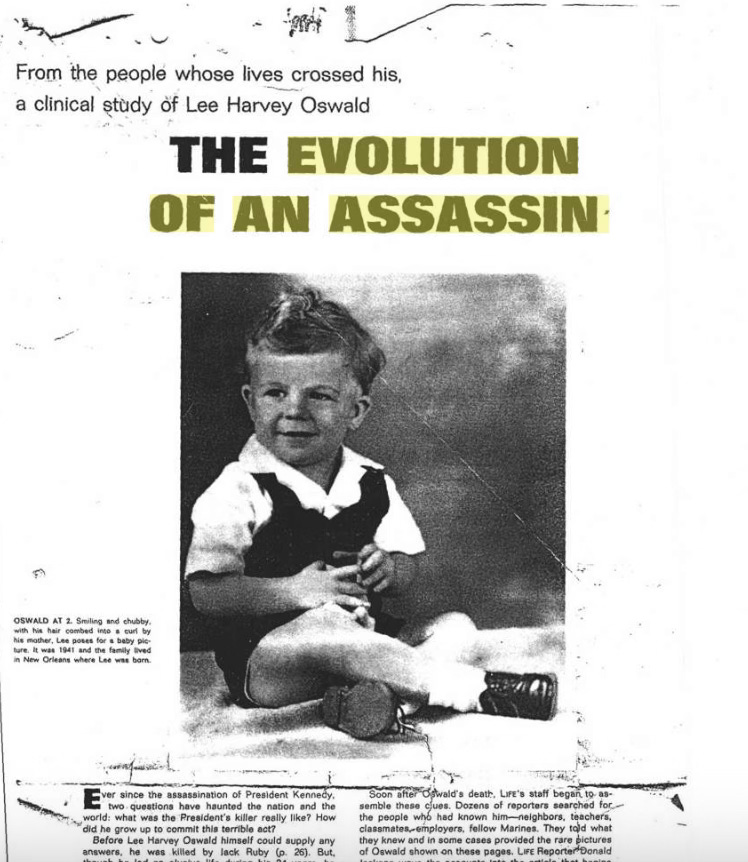
Screenshot of first page of Donald Jackson’s Life Magazine article on Lee Harvey Oswald, Feb. 21,1964., Source: Mary Ferrell archive, PDF pg. 76
With so many military intelligence and CIA figures swirling around Oswald and Ruby, it’s not a great surprise to discover that the man who wrote the most early influential biography of Oswald, “The Evolution of An Assassin," published in Life Magazine on February 21, 1964, had only some three to four years earlier been a CIC agent. As can be seen in a National Archives reproduction of the article, its author, Donald Dale Jackson, or perhaps a Life editor, subtitled the work “a clinical study of Lee Harvey Oswald.” The magazine advertised “in full and extraordinary detail, the life of the assassin.”6
The word “clinical” promised a scientific, psychological, or psychiatric expert presentation that the article could not and did not have. In reality, it was a hatchet job that began with one premise: Oswald was “the president’s killer” (Pg. 68A).
But Lee Harvey Oswald had never been tried for the crime of killing John Kennedy, and therefore was obviously never convicted of the crime either. There are plenty of articles, books, and essays that have argued how Oswald did not get a fair shake, how he was framed for the assassination, or at least could not have committed the crime alone. I am not going to review all these arguments here.
This article explores how Donald Jackson, a 29-year-old journalist who had only recently joined Life magazine after returning to reporting with United Press International following approximately three years in the Counter Intelligence Corps, collaborated with Life’s editors in portraying Lee Oswald as the perpetrator of a heinous crime. The article, the first to take up the issue of Jackson’s military intelligence links, will of necessity touch upon three other important topics: the lies a psychiatrist told about the evaluation of Oswald as a child, lies Jackson repeated in his article; the question of military intelligence presence in Dallas on November 22; and the issue of how familiar local military intelligence figures were with Lee Harvey Oswald and Jack Ruby.
Life Magazine had a long history of collaboration with the U.S. government. Its founder, Henry Luce, had approved the use of the magazine’s assets “as operating covers for intelligence agency officers abroad.” In addition, soon after the assassination the magazine bought the famous Zapruder film of the assassination itself and withheld it from public showing for years. The deal was brokered by Life publisher C.D. Jackson, who had a long career working as a top psychological warfare specialist for the U.S. government.
Interestingly, in November 1966, Texas Governor John Connally, who had been shot along with Kennedy in the motorcade, was allowed to view the Zapruder film. Afterward, Connally told the press, “there is my absolute knowledge, and Nellie’s too, that one bullet caused the President’s first wound, and that an entirely separate shot struck me.” (Nellie Connally, aka Idanell Brill Connally, was John Connally’s wife.)
This powerful refutation of the famed “single bullet” theory, which held that Connally had been hit with one of the two bullets that also struck Kennedy, undermined the authority of the Warren Commission and its single assassin thesis, leading Life Magazine to issue an editorial calling for a new investigation. According to an account in the November 21, 1966 issue of The New York Times, Life’s editors maintained “there was ‘reasonable—and disturbing—doubt’ that Lee Harvey Oswald had acted alone in the assassination of President Kennedy.” They “called for a new official inquiry.”
How did I know Donald Jackson was connected to CIC? I was researching Jackson’s biography and was tipped off to Jackson’s CIC connection when I came across a March 2017 comment left by Steven Uanna for an April 15, 2010 article at David Lifton’s Substack. Following Uanna’s example,7 I queried the Gale Literature Resource Center for details on Jackson’s life, as seen below. The Dale database described Jackson as working for the “U.S. Army, Counter Intelligence Corps” from 1958 to 1960.8
Expand part two
Before continuing, I should explain how it was I even came to investigate Jackson’s past and his credentials.
I recently researched the backgrounds of psychiatrists consulting with the Warren Commission regarding Lee Harvey Oswald’s ostensible motivations for supposedly shooting John Kennedy. It turned out, much to my own surprise, that three of the four psychiatrists contracted as consultants had connections with the CIA. One of them, Dr. Howard Rome, had even been a consultant for the CIA’s Artichoke and MKULTRA mind control programs. Another, Dr. Winfred Overholser, had headed the government’s top secret research study on “truth drugs” during World War II.
It seemed to me that the CIA’s sudden appearance in the corridors of the Warren Commission, in the discussions that would paint Oswald as a crazed assassin, was no accident. As others have pointed out, the footprints of the intelligence world are all over the JFK assassination story, from Oswald’s Dallas “handler,” CIA informant (if he wasn’t more than that) George de Mohrenschildt, to CIA Counterintelligence Chief James Jesus Angleton’s surveillance on Oswald’s “politics, his personal life, his foreign travels, [and] his contacts,” to Jack Ruby’s psychiatric entanglement with CIA MKULTRA doctor Louis Joylan West.
Perhaps because in my pre-retirement career I was a psychologist, I am drawn to the aspect of the JFK assassination mystery that concerns the supposed reconstruction of the Oswald’s life history. I am not alone in thinking this is an important aspect of the overall story surrounding the assassination, particularly in the formative months surrounding the activities of the Warren Commission.
As law professor Jonathan Simon wrote in 1998 for the Yale Journal of Law and the Humanities (Vol. 10: 75):
Oswald’s biography is the conceptual centerpiece of the Warren Report, the symbolic axis on which it turns. For the Warren Commission was charged not only with discovering the truth about the assassination, with discovering its meaning, but also with persuading the American people of that truth. The Commission had to do more than simply trace the bullets that killed President Kennedy to a gun in Lee Harvey Oswald’s hands: It had to fill the empty space of that trajectory with a believable explanation; it had to make sense of what happened. And as the Commission began to edge toward its celebrated thesis that Oswald alone was responsible for the death of the President, it became clear that its Report would have to anchor the truth of the crime inside Lee Harvey Oswald himself.9 [page 77, PDF pg. 3; link to download full article]
When looking at the construction of Oswald’s life and motivations, which unfolded over the first weeks and months after the assassination, a number of early articles stand out. While there were early newspaper stories about Oswald’s ostensible Marxist views, his time in the Soviet Union, and his supposed position as “Secretary” of the pro-Castro Fair Play for Cuba Committee, I am interested in how the psychiatric angle surrounding Oswald’s biography was exploited. The psychiatric narratives were meant to frame Oswald’s supposed motivation for the crime. It took about a week for the mental illness meme to surface.
[

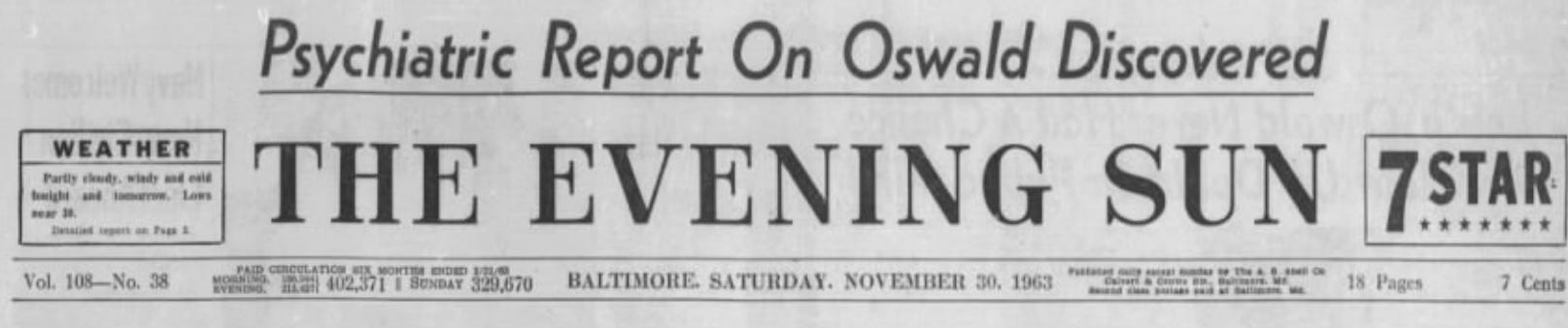
Screenshot of Baltimore paper, The Evening Sun, November 30, 1963, pg. 1. Source: Newspapers.com
On November 30, 1963, the New York Post broke the story about Lee Oswald’s teenage psychiatric history. Apparently the New York Post article did not carry a byline. Frustratingly, I have not been able to find an online copy of the Post story, which was copyrighted and not widely spread beyond the Post itself. But an Associated Press article leaning on the _Post’_s reporting got wide coverage.
The Post article quoted then “presiding justice of the family court,” Florence M. Kelley, who confirmed there was such a psychiatric history and that the court had provided information about it to the FBI, something Kelley knew was ethically dicey because Oswald had been a juvenile. In April 1953, Oswald had been referred to Youth House in the Bronx for chronic Junior High truancy, and received the standard psychiatric and social worker evaluations for that time.
The Post’s real dirt came from anonymous sources. The paper reported:
“It was learned from other sources that the psychiatric report recommended young Oswald, then only 13, for commitment…. The recommendation was turned down by the court.
“The probation report found schizophrenic tendencies and said that Oswald was potentially dangerous.”
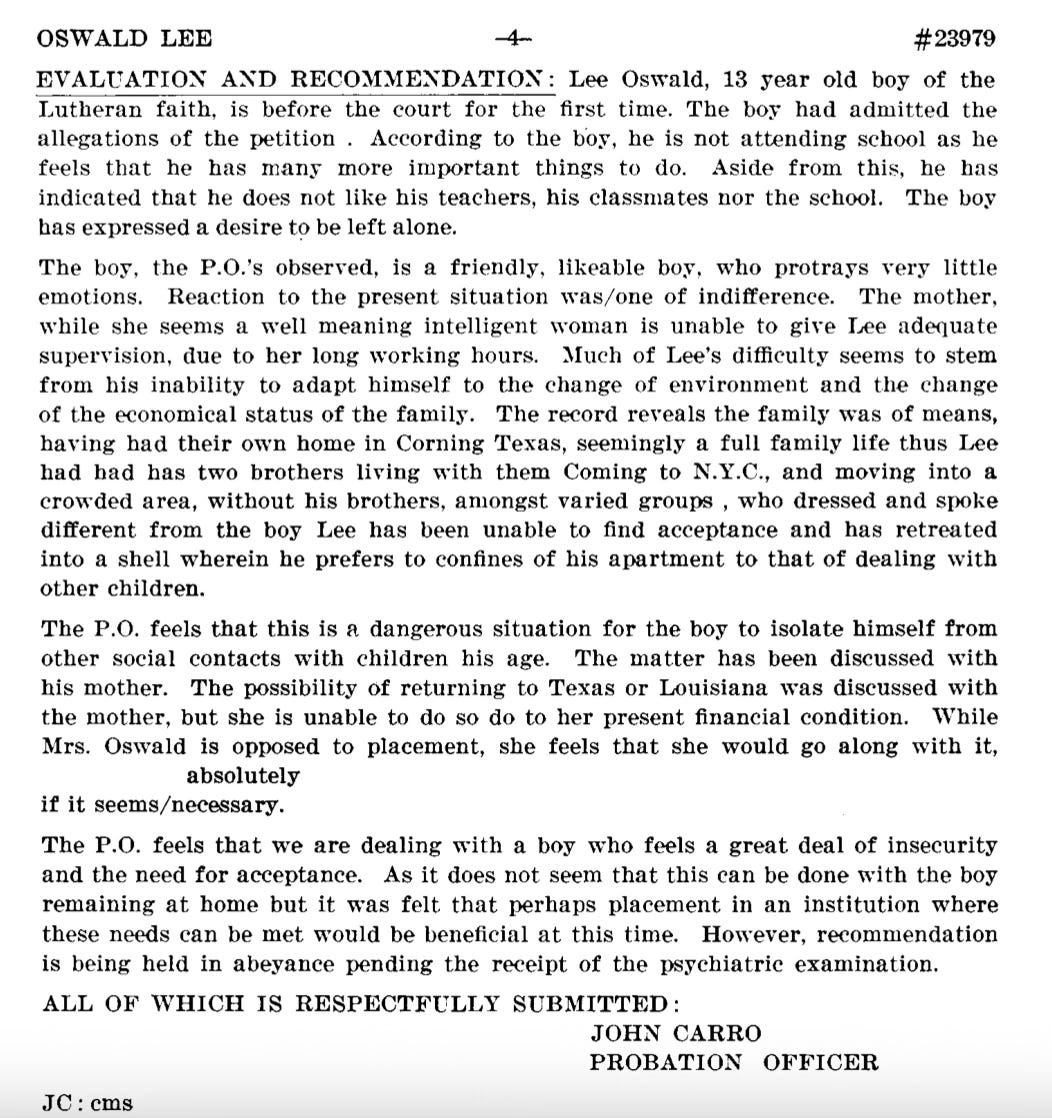
These were all lies. Below is a copy of the report by Oswald’s probation officer, John Carro. The only “dangerousness” was to Oswald, from the possibility that the young boy would remain isolated from “social contacts with other children his age,” according to Carro.
[

Screenshot of John Carro’s probation report on Lee Oswald, May 1, 1953, PDF pg. 8. Source: History-matters.com
As one can readily see from Carro’s report, there had been some talk of institutionalizing young Lee, but a final decision awaited “the receipt of the psychiatric examination.” That assessment was the job of Dr. Renatus Hartogs, the head psychiatrist at Youth House. Hartogs, who had been a psychiatrist at Sing Sing prison before coming to Youth House, would play a crucial role in the formation of the Oswald legend, portraying the youngster — years later, and only after the assassination — as a volatile, dangerous, mentally deranged teenager. In fact, that is what Hartogs would tell newspaper reporters and the Warren Commission. But the documentary evidence doesn’t back up that narrative. And, notably, the Warren Commission wasn’t buying it either.
The press continued to vilify Oswald, building to a major article in the December 8, 1963 New York Times, “Lee Harvey Oswald: The Man and the Mystery.” Written by Donald Janson, in a nod towards fairness the article referred to Lee as “the accused assassin,” but the neutrality ended there. It was, in fact, a hit piece. In addition, it relied on Hartogs’ retrospective report for scientific evidence:
… the life story of the secretive young malcontent has not been completely pieced together, but what is known casts some light on the troubled man and the mystery he created just before his death….
He was absent 47 days from Junior High School 117 from October, 1952, to January, 1953. John Carro became his probation officer. He found that the 13-year-old youngster was staying home and watching television in the Oswald’s small furnished apartment much of the day. Neighbors reported that he played alone with toy guns.10 Mr. Carro found him a withdrawn and friendless child who was taunted at school because of his Southern drawl and because he wore blue jeans….
A fourth judge sent him to the Youth House for Boys in the Bronx. He was examined for a month there in 1953. The chief psychiatrist, Dr. Renatus Hartogs, found that the slim 13-year-old had schizophrenic tendencies and was “potentially dangerous.” This examination, performed 10 years ago, found Oswald to be full of anger although outwardly calm. It found he had fantasies involving violence. The fatherless boy had a hatred of authority, fixed on a father symbol. His personality was unruffled, seclusive, aggressive.
Expand part three
Why was “potentially dangerous” in quotes, because there is no such quote in Hartogs’ report on Oswald? Was Janson quoting Hartogs directly? Whether or not Hartogs himself was the source for Janson’s article, below is a relevant portion of Hartogs’ testimony before the Warren Commission on April 16, 1964. Recalling that he remembered Oswald years later, after the assassination, because he had given an informal seminar on his case at Youth House, Hartogs said:
We gave a seminar on this boy in which we discussed him, because he came to us on a charge of truancy from school, and yet when I examined him, I found him to have definite traits of dangerousness. In other words, this child had a potential for explosive, aggressive, assaultive acting out which was rather unusual to find in a child who was sent to Youth House on such a mild charge as truancy from school. This is the reason why I remember this particular child, and that is the reason why we discussed him in the seminar. [pg. 217]
[

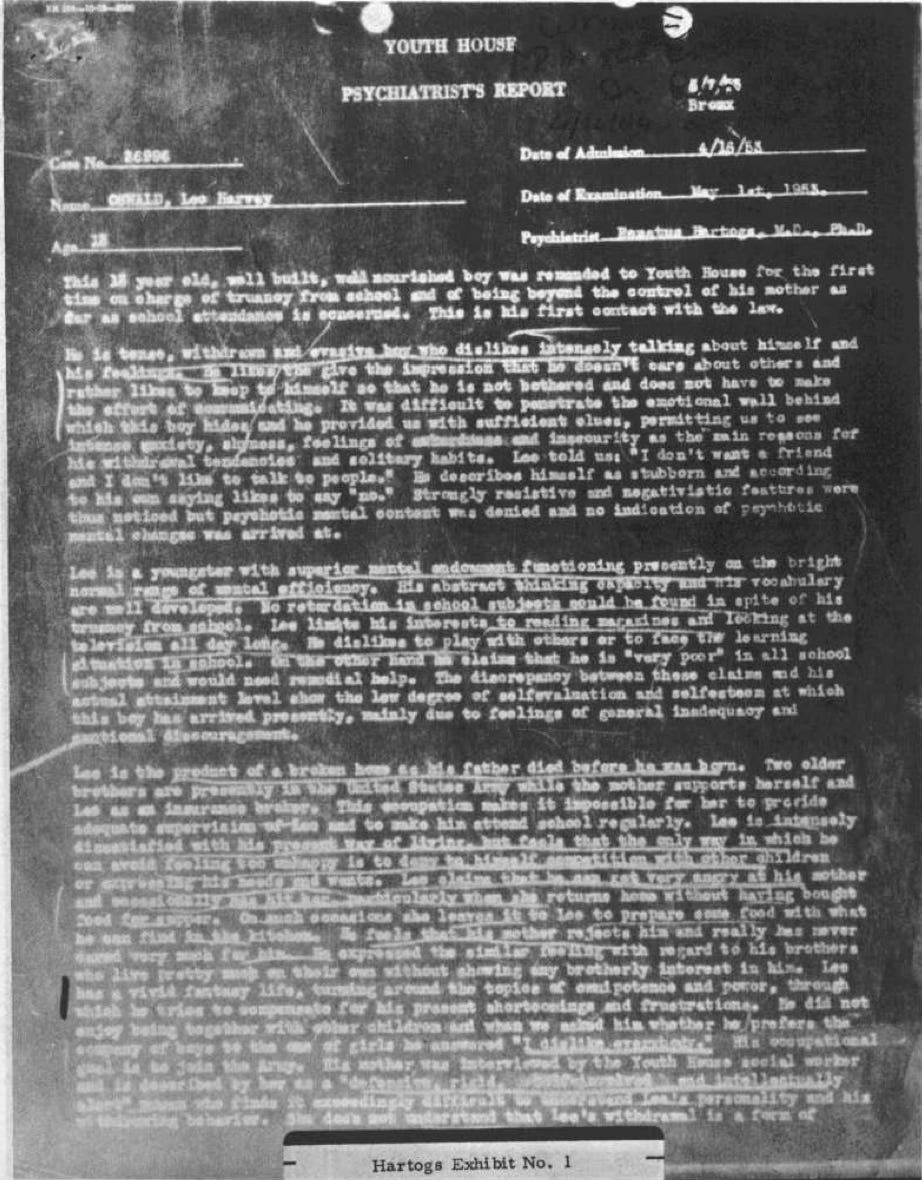
Screenshot of first page of Dr. Hartogs’s May 1953 psychiatric report on Lee Oswald. Source: history-matters.com
As I wrote elsewhere:
According to the WC report, “Contrary to reports that appeared after the assassination, [Hartog’s] psychiatric examination did not indicate that Lee Oswald was a potential assassin, potentially dangerous, that ‘his outlook on life had strongly paranoid overtones’ or that he should be institutionalized.” [See Chapter 7, pg. 379]
Contrary to the documentary record, Dr. Hartogs, who testified before the Warren Commission on April 16, 1964, told his examiners, “If I can recall correctly, I recommended that this youngster should be committed to an institution.” Hartogs did all he could to condemn Oswald to the authorities, once he realized that Oswald was the child he had evaluated eleven years earlier. He told the FBI that the young Oswald had “extremely cold, steely eyes… there was nothing emotional, affective about him.” Oswald’s “suspiciousness towards adults” showed he had a “severe personality disorder.”
When [Warren Commission Assistant Counsel, Wesley] Liebeler showed Hartogs a copy of his original psychiatric report, the report presented a very different picture of Oswald, one that recommended probation and not a “more harmful placement approach,” such as psychiatric commitment. Hartogs could not account for the difference between his report, which said nothing about dangerousness, and his memory. A somewhat blurred copy of Hartogs’ report is available here [and inserted above]; and here is a textual, cleaned-up version of the report. Nothing of Hartogs’ contradictory testimony to Warren Commission examiners ever made it into the [Warren] report. [italics for emphasis and bracketed material is added]
Amazingly, when Liebeler confronted Hartogs with his mischaracterizations about his report to the Warren Commission, Hartogs had little to say about it except to plea that he was relying on memory for events then some ten years in the past. But more amazing is the fact that even after his confrontation with Liebeler, Hartogs returned to his bogus summation of the Oswald report, with claims about Oswald’s “dangerousness,” “schizophrenia,” propensity to violence, etc., for years afterward.
[

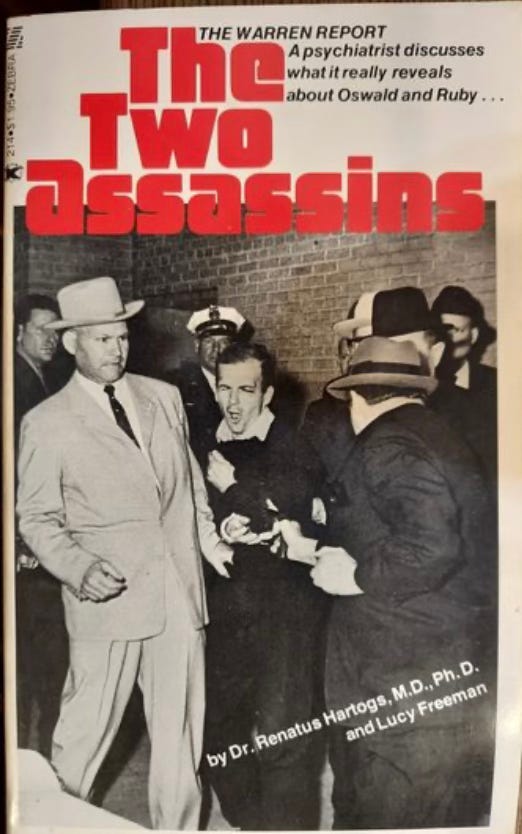
Cover of soft cover version (1976) of The Two Assassins, by Renatus Hartogs and Lucy Freeman. Source: biblio.com
In 1965, Hartogs authored, along with journalist Lucy Freeman, the book The Two Assassins. I am working on obtaining a copy of Hartogs and Freedman’s book, but I was able to see via Google Books’ entry that the initial chapter is called, “The Twisted World of Lee Harvey Oswald.” Apparently, in the book Hartogs also provided his supposed psychiatric expertise on the “second assassin,” Jack Ruby, killer of Lee Oswald (although, as Paul Abbott has shown, there may even be questions about Ruby as the shooter).11
According to a book review of the Hartogs-Freeman text, the book still repeated the same old slanders and lies about the young Oswald. “This child is explosively dangerous and we can expect him to commit an act of violence during his lifetime if he does not get help in understanding his fury,” Hartogs claimed in the book, indicating this was something he wrote down after evaluating Oswald. Of course, nothing like that was in his 1953 report on young Lee, and has never surfaced in any other report.
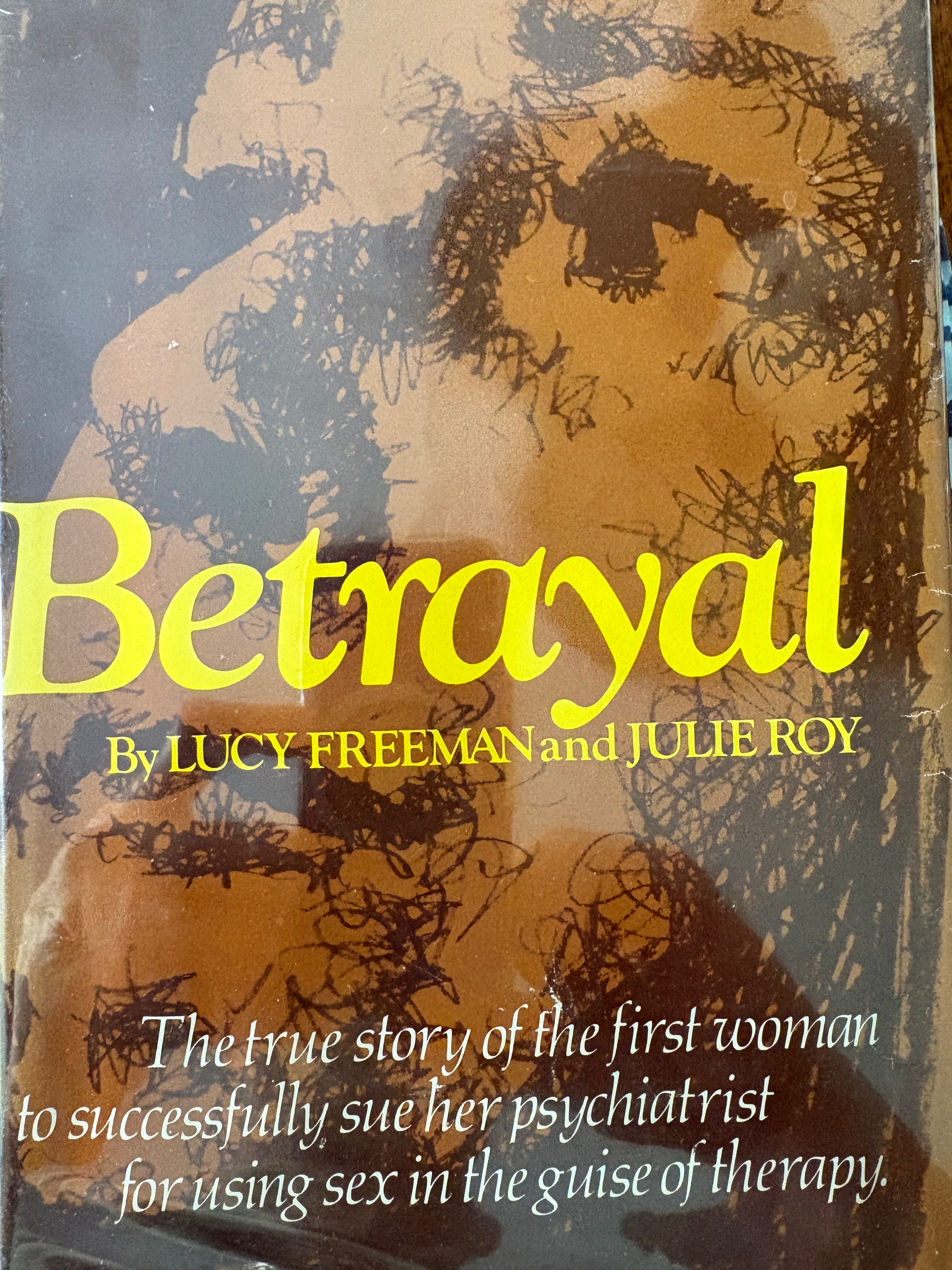
The press deserves a huge share of the blame for spreading Hartogs’ lies. The European-born Hartogs comes off as a self-promoter and highly unethical. It is with some irony that his career ended approximately ten years after the publication of The Two Assassins, when a jury found him guilty of coercing sex repeatedly with his patient Julie Roy, a secretary at Esquire Magazine. Ms. Roy later wrote a book about all this with Lucy Freeman — the same journalist who co-wrote Hartogs’ Assassins book! That book was titled Betrayal: The true story of the first woman to successfully sue her psychiatrist for using sex in the guise of therapy.
It’s a sordid tale I will leave the reader to pursue if they wish. In the end, a jury agreed that Hartogs was guilty of malpractice and awarded Roy “$250,000 in compensatory and $100,000 in punitive damages,” which was reduced later upon appeal. Hartogs, who was then 67 years old, gave up his license “to avoid state disciplinary procedures,” according to one newspaper account. I will only remark that, one, the verdict and Hartogs’ actions speak to his lack of professional ethics. Two, Lucy Freeman certainly seemed to get around! Perhaps the latter book was some kind of penance for her initial work with Hartogs.12
It is worth citing here for the record Hartogs’ original summary of his evaluation of the young teen Oswald, which was passed on to Oswald’s probation officer. I think given the pervasiveness of the lies about his report, which have circulated for decades now, the full text of that summary should not be passed over here. In addition, Hartogs’ original summary makes a nice preface for the discussion below on the distortions of the psychiatric record Donald Jackson will retail in his infamous Life Magazine article.
Expand part four
This 13 year old well built boy has superior mental resources and functions only slightly below his capacity level in spite of chronic truancy from school which brought him into Youth House. No finding of neurological impairment or psychotic mental changes could be made. Lee has to be diagnosed as “personality pattern disturbance with schizoid features and passive-aggressive tendencies.” Lee has to be seen as an emotionally, quite disturbed youngster who suffers under the impact of really existing emotional isolation and deprivation, lack of affection, absence of family life and rejection by a selfinvolved and conflicted mother. Although Lee denies that he is in need of any other form of help other than “remedial” one, we gained the definite impression that Lee can be reached through contact with an understanding and very patient psychotherapist and if he could be drawn at the same time into group psychotherapy. We arrive therefore at the recommendation that he should be placed on probation under the condition that he seek help and guidance through contact with a child guidance clinic, where he should be treated preferably by a male psychiatrist who could substitute, to a certain degree at least, for the lack of a father figure. At the same time, his mother should be urged to seek psychotherapeutic guidance through contact with a family agency. If this plan does not work out favorably and Lee cannot cooperate in this treatment plan on an out-patient’s basis, removal from the home and placement could be resorted to at a later date, but it is our definite impression that treatment on probation should be tried out before the stricter and therefore possibly more harmful placement approach is applied to the case of this boy. The Big Brother Movement could be undoubtedly of tremendous value in this case and Lee should be urged to join the organized group activities of his community, such as provided by the PAL or YMCA of his neighborhood.
As the above text shows, Hartogs found the 13-year-old Oswald to be intelligent, non-psychotic, lacking neurological impairment, with no personality “disorder.” The statement that one has “features” or “tendencies” of personality disturbance means — and I have written dozens of psychological evaluations for attorneys in my career, and testified on them as an expert witness in court — that some or a few symptoms were present consistent with certain “personality patterns” that had relevance in the case. In Lee’s case the symptoms were shyness and aloofness (“schizoid” traits), and a certain resistance to being treated by adults he did not trust (“passive-aggressive” to “professionals” like Hartogs).
[

Front cover of Lucy Freeman and Julie Roy’s 1976 book, Betrayal_, Stein & Day Publishers, 1976. Photo: Jeffrey Kaye_
Rather than someone to be committed to a psychiatric hospital or setting, Lee Oswald was at that time understood to be a child who “suffers under the impact of really existing emotional isolation and deprivation, lack of affection, absence of family life and rejection by a selfinvolved and conflicted mother.” The emphasis on blaming the mother is a common one in psychiatry and psychology and Dr. Hartogs and the people at Youth House had little seeming sympathy for a working-class mother struggling to make a living, bring up children after the death of a spouse, and still have some kind of satisfying life for herself. What Lee needed, Hartogs felt, was a consistent father figure, someone like a Big Brother or the leader of a YMCA group activity. He did not need institutionalization.
Rather than a young monster, Lee was a child who could “be reached through contact with an understanding and very patient psychotherapist.” In other words, he was relatable, and in fact, that is how some of Oswald’s teachers and social worker found him to be.
But that is not how Hartogs described Lee years later to the newspapers, nor how he apparently portrayed him in his book, The Two Assassins.
Returning to Jackson’s Life Magazine article, the former CIC man oversold Hartogs’ evaluation of the young adolescent Oswald as “[t]he most penetrating personality analysis ever made on Lee Oswald” (pg. 71). The Warren Commission’s quiet debunking of Hartogs’ assessment wouldn’t be published until their entire report was released to the public on September 27, 1964. Hence, Jackson may not have had access to other critiques of Hartogs’s work. But he didn’t have access to Hartogs’ report either. That didn’t apparently stop Jackson, who wrote, “the substance of [Hartog’s report] is as follows” (in part):
It was apparent that Oswald was an emotionally disturbed, mentally constricted youngster who tended to isolate himself from contacts with others, was suspicious and defiant in his attitude toward authority, and overly sensitive and vengeful in his relationships with his peers…. [he] did not seem to have developed the courage to act upon his hostility in an aggressive or destructive fashion. He also appeared to be preoccupied about his sexual identity and his future role as a male.
He was guarded, secluded and suspicious in his dealings with the psychiatrist…. He could not become verbally productive and talk freely about himself and his feelings….
Dr. Hartogs concluded that here was definitely a child who had given up hope of making himself understood by anyone about his needs and expectations. In an environment where affection was withheld, he was unable to relate with anyone because he had not learned the techniques and skills which would have permitted it. A diagnosis of incipient schizophrenia was made, based on the boy’s detachment from the world and pathological changes in his value systems. His outlook on life had strongly paranoid overtones. The immediate and long-range consequence of these features, in addition to his inability to verbalize hostility, led to an additional diagnosis: “potential dangerousness.”
Dr. Hartogs’ report was sent to the Children’s Court with the recommendation that the child be committed to an institution for his own protection and that of the community at large. He felt that the treatment might have led to improvement, and that ultimately the boy would have been rehabilitated. His recommendation was not followed. [Jackson, “The Evolution of an Assassin,” February 21, 1964, Life Magazine, pg. 72]
“Emotionally disturbed, mentally constricted… suspicious and defiant… overly sensitive and vengeful… hostility… preoccupied about his sexual identity… guarded, secluded and suspicious… unable to relate with anyone… incipient schizophrenia… detachment from the world and pathological changes in his value systems… strongly paranoid… ‘potential dangerousness’”!
It is difficult to believe so many negative connotations about a youngster is even possible, especially one whose only great crimes thus far in his life had been truancy and a reluctance to open up freely to state psychiatry and child custody officials, a child they knew had been recently teased and likely bullied in school. But it’s important to remember this was not the characterization of Oswald’s psychiatrist back in 1953. This was Hartogs’ portrayal of Oswald to Donald Jackson of Life Magazine.
Hartogs further told Jackson “he was not surprised when Lee Oswald was arrested for the assassination of President Kennedy. ‘Psychologically,’ [Hartogs] said he had all the qualifications of being a potential assassin…. A person like Oswald resents a lifetime of being pushed to the sidelines. He culminates his career of injustice-collecting by committing a supreme, catastrophic act of violence and power” (pg. 72)
Expand to the point the Markdown tool shit itself STOP TYPING MISTER KAYE THE COMPUTER IS ANGRY (it continues after this just click the link)
A cursory perusal of the graphic subheads throughout the Life article shows the narrative working on a meta-formatting level. Oswald’s “evolution” into an assassin is revealed here in capsule. From the able young boy to the alienated and “lost” adolescent, to the hermit-like Marine, to the abusive and insensitive husband, to someone who was losing control and seeking violent actions, until he “poked a rifle out that window” on the sixth floor of the Texas School Book Depository.
And who was there to snap a photo of the building and the sixth floor window within five minutes of the assassination? Sergeant James W. Powell of the 112th Intelligence Corps Group.
[

[

[

[

[

[