

Formless Oedon
Contact information:

- 156 Posts
- 71 Comments



 1·1 day ago
How about Mullvad advertising quantum protection or whatever?

You know what I’m gonna go beast mode here. You can completely eliminate the refractory period by doing simple exercises with the muscle that you use not to pee. I’ve said too much. I don’t wanna be gross. It’s a #healthconcern #loggingoff #notreadingreplies
 1·3 days ago
Sorry for not posting enough!
 2·3 days ago
It will bring me immense pleasure to see you people rip each other to shreds like wild dogs.
Expand sources
-
Larry Kilpatrick, “Profile of US Intelligence in Southeast Asia,” Covert Action Information Bulletin, July-August 1979, 5. ↑
-
Waller, The Determined Spy, 413. ↑
-
Waller, The Determined Spy, 273. ↑
-
Idem. ↑
-
Waller, The Determined Spy, 313. ↑
-
Waller, The Determined Spy, 304. ↑
-
Idem. ↑
-
Waller, The Determined Spy, 316. ↑
-
Waller, The Determined Spy, 324. ↑
-
Idem. After the Shah was installed, the CIA secretly delivered more than $5 million to General Fazlollah Zahedi so he could meet government payrolls. ↑
-
Waller, The Determined Spy, 362. ↑
-
Waller, The Determined Spy, 374. ↑
-
Waller, The Determined Spy, 362. ↑
-
Waller, The Determined Spy, 383. ↑
-
Waller, The Determined Spy, 376. ↑
-
Waller, The Determined Spy, 378. ↑
-
Waller, The Determined Spy, 401. ↑
-
Waller, The Determined Spy, 456. ↑
-
Waller, The Determined Spy, 489. Wisner supported Lyndon Johnson’s escalation of the Vietnam War. ↑
-
Waller, The Determined Spy, 501. Wisner was delighted that his son, Frank Jr., became employed by the U.S. Embassy in Saigon. His daughter and son Graham opposed the Vietnam War. ↑
-
Waller, The Determined Spy, 501. ↑
-
Waller, The Determined Spy, 512. ↑
-
Waller, The Determined Spy, 520. Tenet said that Wisner pioneered “some of the most intricate and challenging undertakings of the CIA in its early years.” ↑
-
Expand sources
-
Stewart Alsop had served with the OSS in World War II, parachuting behind enemy lines in Nazi-occupied France. Stay tuned for a future CovertAction Magazine article that focuses on the Alsop’s. ↑
-
A lot of drinking and flirtation went on at these dinners. ↑
-
Douglas Waller, The Determined Spy: The Turbulent Life and Times of CIA Pioneer Frank Wisner (New York: Dutton, 2025). ↑
-
Waller, The Determined Spy, 29. ↑
-
Waller, The Determined Spy, 33. Franklin D. Roosevelt had worked for four years for the same law firm. ↑
-
Waller, The Determined Spy, 34, 35. ↑
-
Waller, The Determined Spy, 80. ↑
-
Waller, The Determined Spy, 81. ↑
-
Waller, The Determined Spy, 99. ↑
-
Waller, The Determined Spy, 100. ↑
-
Wisner had lamented the American indifference as the Soviets established control over Romania. ↑
-
Waller, The Determined Spy, 109, 111. ↑
-
Waller, The Determined Spy, 114. ↑
-
Waller, The Determined Spy, 121. ↑
-
Waller, The Determined Spy, 121, 170. ↑
-
Waller, The Determined Spy, 269, 270. ↑
-
Waller, The Determined Spy, 270. ↑
-
Idem. Eventually the CIA had a falling out with Gehlen and began spying on him. ↑
-
Waller, The Determined Spy, 155. ↑
-
Waller, The Determined Spy, 157. Wisner may have been involved with an Operation Bloodstone which aimed to recruit Soviet emigrés, who could be used as spies or penetration agents against the Soviet Union. According to historian Jeffrey Kaye, its activities included “recruiting defectors, smuggling refugees out from behind the Iron Curtain, and assassinations.” ↑
-
Cakars and Osborne noted that “in some cases, those targeted for elimination seem to have been people merely resisting OUN-B financial shakedowns, or were the unfortunate victims of personal grudges.” This is similar to the Vietnam Phoenix Operation, which Operation Ohio set the precedent for. Three veterans of Operation Ohio worked directly in Phoenix, including future CIA Director Richard Helms. Osborne incidentally was a Phoenix program veteran and whistleblower. See Douglas Valentine, The Phoenix Program (New York: Robert Morrow, 1990). Historian Jeffrey Kaye details how in the Mittenwald DP camp in the Bavarian Alps after World War II the OUN killers, using “techniques borrowed from the Nazis,” burned the bodies of those they killed “in large bread baking ovens” they were given acces to by American soldiers. ↑
-
Waller, The Determined Spy, 163. ↑
-
Waller, The Determined Spy, 165, 212. ↑
-
Waller, The Determined Spy, 166. ↑
-
Waller, The Determined Spy, 173. ↑
-
Waller, The Determined Spy, 174. ↑
-
Waller, The Determined Spy, 267. ↑
-
Waller, The Determined Spy, 269. ↑
-
Waller, The Determined Spy, 180. ↑
-
Waller, The Determined Spy, 269. ↑
-
Waller, The Determined Spy, 181. Wisner’s officers found non-communist leftists in Europe more reliable in fighting communism than rightists. The Congress for Cultural Freedom (CCF) was chaired by Sidney Hook, a New York University philosophy professor and “reformed” communist who served as a consultant to CIA Director Walter Bedell Smith (1950-1953). ↑
-
Waller, The Determined Spy, 205. ↑
-
Waller, The Determined Spy, 417. ↑
-
Philip F. Nelson, Who REALLY Killed Martin Luther King Jr.? The Case Against Lyndon B. Johnson and J. Edgar Hoover, new foreword by Edgar F. Tatro (New York: Skyhorse Publishing, 2018), xxvi; Deborah Davis, Katherine the Great: Katherine Graham and Her Washington Post Empire (New York: Sheridan Square Press, 1979). ↑
-
Carl Bernstein, “The CIA and the Media,” Rolling Stone, October 20, 1977. ↑
-
For the latter case, see Peter Dale Scott, “Air America: Flying the U.S. Into Laos,” in Laos: War and Revolution, ed. Alfred W. McCoy and Nina Adams (New York: Harper & Row, 1970), 310, 311. ↑
-
Waller, The Determined Spy, 186. ↑
-
Waller, The Determined Spy, 214. ↑
-
Waller, The Determined Spy, 189. ↑
-
Waller, The Determined Spy, 192. A U.S. intelligence estimate concluded that resistance inside Albania represented only a “nuisance” for the regime, certainly “not an immediate threat.” ↑
-
Waller, The Determined Spy, 292. ↑
-
Waller, The Determined Spy, 224; James P. Bevill, Spies in Saigon: CIA Covert Operations in French Indochina and South Vietnam 1950-1963 (Atglen, PA: Schiffer Military History, 2026), 282. Wisner selected Paul Springer, who had headed CIA operations in Vietnam during the 1st Indochina War (1946-1954) to oversee the training base in Saipan. Some Iranians were trained there who went to Iran to support the CIA’s 1953 coup and the Shah. ↑
-
Waller, The Determined Spy, 197. ↑
-
Waller, The Determined Spy, 227. Waller further noted that “the propaganda broadcasts and seventy-five million leaflets dropped on Mainland China had little impact. Hundreds of agents infiltrated into communist-controlled territory were forced to send back fabricated intelligence reports after being captured.” ↑
-
Waller, The Determined Spy, 227; Bevill, Spies in Saigon, 279. ↑
-
David A. Foy, Superspy: Hans Tofte, Intelligence Officer for SOE, OSS, and CIA (Pennsylvania: Casemate, 2025), 90; Annie Jacobsen, Surprise, Kill, Vanish: The Secret History of CIA Paramilitary Armies, Operators and Assassins (Boston: Little, Brown & Company, 2019), 40, 41. Foy suggests that Buffalo may have been programmed as an assassin through mind control experiments overseen by Tofte in Japan that were a prelude to the Operation MK-ULTRA. ↑
-
Waller, The Determined Spy, 233. See also John Delury, Agents of Subversion: The Fate of John T. Downey and the CIA’s Covert War in China (Ithaca, NY: Cornell University Press, 2022). ↑
-
Waller, The Determined Spy, 233. See also Alfred W. McCoy, The Politics of Heroin: CIA Complicity in the Global Drug Trade (New York: Lawrence Hill Books, 2003). ↑
-
Waller, The Determined Spy, 232. ↑
-
David H. Price, Cold War Deceptions: The Asia Foundation and the CIA (Seattle: University of Washington Press, 2024). Wisner also helped set up Radio Free Asia and the Committee for a Free Asia. ↑
-
Waller, The Determined Spy, 228, 229. ↑
-
Waller, The Determined Spy, 230. ↑
-
This is exactly what I wanted to read right now! 😁
 5·4 days ago
You owe them a lot more than that without the war at all!
I have the same question lol, I have some stuff ready to be automated and the rest is going to be autoposted when I share it with an Arcane Chat bot, drop a link in a bookmark folder, or enter it in a command line tool. Is this just cyborg posting or am I a bot now
Sadly it’s in a pretty battered state, so I’m still on Jerboa and browser. It had some good features in mind.
“What are we, a bunch of Russians?”
Internets origins lie in the Semi-Automated Ground Environment & the Phoenix Program. It was rolled out to CIA-approved universities & invite-only sites for journalists. It will still be part of a bright future. Technology looks sinister when it is held in its most developed forms by the worst people imaginable. They’re already scared of what they started.

Guys this wasn’t a trick question it’s not that hard
🔥🔥👆 USER CAPABLE OF EXPERIENCING JOY
Young men and women should be in cities, not just for meeting people, it has myriad benefits. Please don’t rob yourself of the richness that comes with it! Rural areas can be so very hard! If you have to switch jobs, less availability, and it will be almost impossible to maintain good travel time for doing anything or seeing anyone. You have so much agency to change your life in a city versus driving through the void, burning gas.
What does that have to do with anything? Maybe you have a vitamin deficiency
EDIT: oh sorry I don’t fancy the usual “I’m too sleepy to deal with DECADES-old Hitlerite propaganda used to justify killing untold numbers of people in West Asia” bit. The world is not that big and time isn’t that long. Grow up!
Expand to the point the Markdown tool shit itself STOP TYPING MISTER KAYE THE COMPUTER IS ANGRY (it continues after this just click the link)
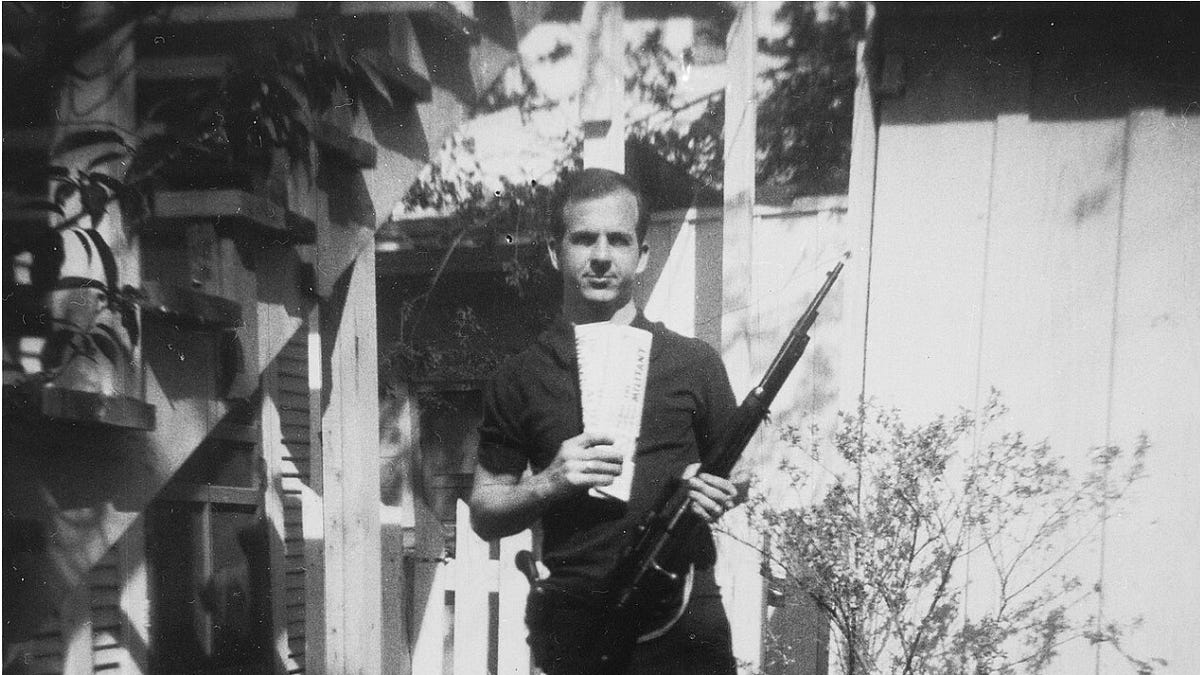
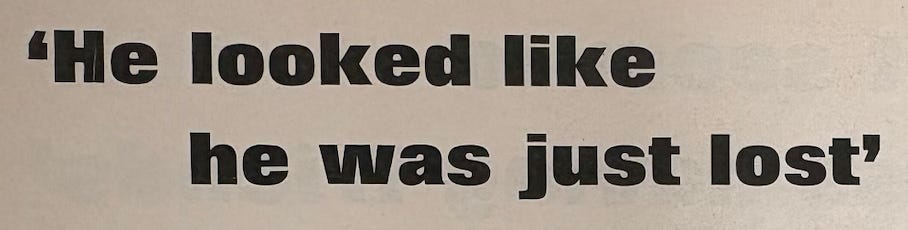
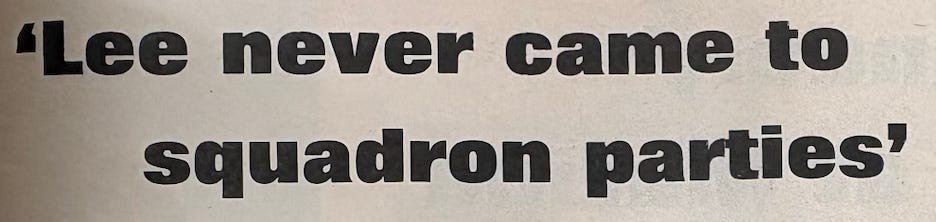
A cursory perusal of the graphic subheads throughout the Life article shows the narrative working on a meta-formatting level. Oswald’s “evolution” into an assassin is revealed here in capsule. From the able young boy to the alienated and “lost” adolescent, to the hermit-like Marine, to the abusive and insensitive husband, to someone who was losing control and seeking violent actions, until he “poked a rifle out that window” on the sixth floor of the Texas School Book Depository.
And who was there to snap a photo of the building and the sixth floor window within five minutes of the assassination? Sergeant James W. Powell of the 112th Intelligence Corps Group.
[

[

[

[

[

[

Expand part four
This 13 year old well built boy has superior mental resources and functions only slightly below his capacity level in spite of chronic truancy from school which brought him into Youth House. No finding of neurological impairment or psychotic mental changes could be made. Lee has to be diagnosed as “personality pattern disturbance with schizoid features and passive-aggressive tendencies.” Lee has to be seen as an emotionally, quite disturbed youngster who suffers under the impact of really existing emotional isolation and deprivation, lack of affection, absence of family life and rejection by a selfinvolved and conflicted mother. Although Lee denies that he is in need of any other form of help other than “remedial” one, we gained the definite impression that Lee can be reached through contact with an understanding and very patient psychotherapist and if he could be drawn at the same time into group psychotherapy. We arrive therefore at the recommendation that he should be placed on probation under the condition that he seek help and guidance through contact with a child guidance clinic, where he should be treated preferably by a male psychiatrist who could substitute, to a certain degree at least, for the lack of a father figure. At the same time, his mother should be urged to seek psychotherapeutic guidance through contact with a family agency. If this plan does not work out favorably and Lee cannot cooperate in this treatment plan on an out-patient’s basis, removal from the home and placement could be resorted to at a later date, but it is our definite impression that treatment on probation should be tried out before the stricter and therefore possibly more harmful placement approach is applied to the case of this boy. The Big Brother Movement could be undoubtedly of tremendous value in this case and Lee should be urged to join the organized group activities of his community, such as provided by the PAL or YMCA of his neighborhood.
As the above text shows, Hartogs found the 13-year-old Oswald to be intelligent, non-psychotic, lacking neurological impairment, with no personality “disorder.” The statement that one has “features” or “tendencies” of personality disturbance means — and I have written dozens of psychological evaluations for attorneys in my career, and testified on them as an expert witness in court — that some or a few symptoms were present consistent with certain “personality patterns” that had relevance in the case. In Lee’s case the symptoms were shyness and aloofness (“schizoid” traits), and a certain resistance to being treated by adults he did not trust (“passive-aggressive” to “professionals” like Hartogs).
[

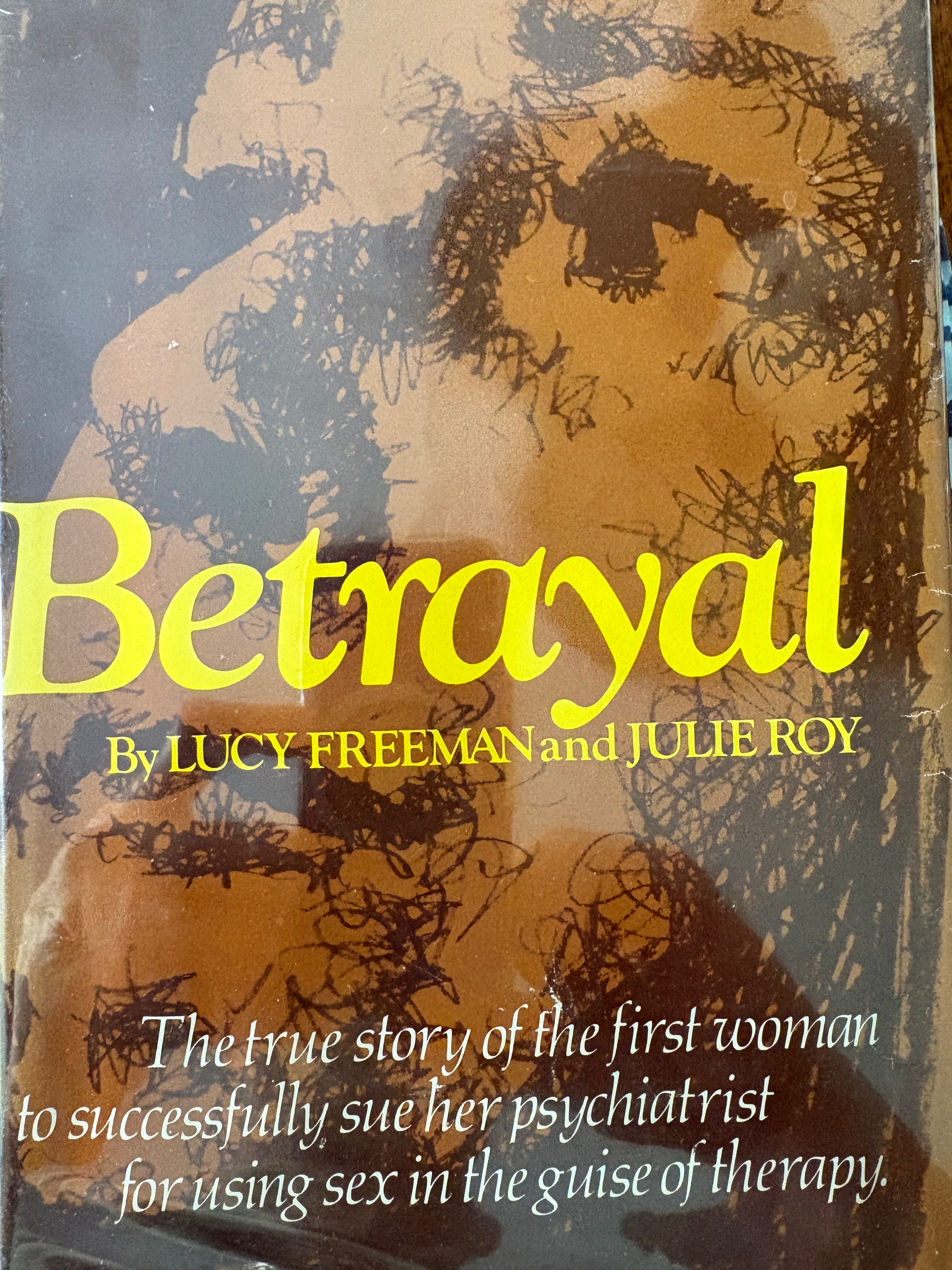
Front cover of Lucy Freeman and Julie Roy’s 1976 book, Betrayal_, Stein & Day Publishers, 1976. Photo: Jeffrey Kaye_
Rather than someone to be committed to a psychiatric hospital or setting, Lee Oswald was at that time understood to be a child who “suffers under the impact of really existing emotional isolation and deprivation, lack of affection, absence of family life and rejection by a selfinvolved and conflicted mother.” The emphasis on blaming the mother is a common one in psychiatry and psychology and Dr. Hartogs and the people at Youth House had little seeming sympathy for a working-class mother struggling to make a living, bring up children after the death of a spouse, and still have some kind of satisfying life for herself. What Lee needed, Hartogs felt, was a consistent father figure, someone like a Big Brother or the leader of a YMCA group activity. He did not need institutionalization.
Rather than a young monster, Lee was a child who could “be reached through contact with an understanding and very patient psychotherapist.” In other words, he was relatable, and in fact, that is how some of Oswald’s teachers and social worker found him to be.
But that is not how Hartogs described Lee years later to the newspapers, nor how he apparently portrayed him in his book, The Two Assassins.
Returning to Jackson’s Life Magazine article, the former CIC man oversold Hartogs’ evaluation of the young adolescent Oswald as “[t]he most penetrating personality analysis ever made on Lee Oswald” (pg. 71). The Warren Commission’s quiet debunking of Hartogs’ assessment wouldn’t be published until their entire report was released to the public on September 27, 1964. Hence, Jackson may not have had access to other critiques of Hartogs’s work. But he didn’t have access to Hartogs’ report either. That didn’t apparently stop Jackson, who wrote, “the substance of [Hartog’s report] is as follows” (in part):
It was apparent that Oswald was an emotionally disturbed, mentally constricted youngster who tended to isolate himself from contacts with others, was suspicious and defiant in his attitude toward authority, and overly sensitive and vengeful in his relationships with his peers…. [he] did not seem to have developed the courage to act upon his hostility in an aggressive or destructive fashion. He also appeared to be preoccupied about his sexual identity and his future role as a male.
He was guarded, secluded and suspicious in his dealings with the psychiatrist…. He could not become verbally productive and talk freely about himself and his feelings….
Dr. Hartogs concluded that here was definitely a child who had given up hope of making himself understood by anyone about his needs and expectations. In an environment where affection was withheld, he was unable to relate with anyone because he had not learned the techniques and skills which would have permitted it. A diagnosis of incipient schizophrenia was made, based on the boy’s detachment from the world and pathological changes in his value systems. His outlook on life had strongly paranoid overtones. The immediate and long-range consequence of these features, in addition to his inability to verbalize hostility, led to an additional diagnosis: “potential dangerousness.”
Dr. Hartogs’ report was sent to the Children’s Court with the recommendation that the child be committed to an institution for his own protection and that of the community at large. He felt that the treatment might have led to improvement, and that ultimately the boy would have been rehabilitated. His recommendation was not followed. [Jackson, “The Evolution of an Assassin,” February 21, 1964, Life Magazine, pg. 72]
“Emotionally disturbed, mentally constricted… suspicious and defiant… overly sensitive and vengeful… hostility… preoccupied about his sexual identity… guarded, secluded and suspicious… unable to relate with anyone… incipient schizophrenia… detachment from the world and pathological changes in his value systems… strongly paranoid… ‘potential dangerousness’”!
It is difficult to believe so many negative connotations about a youngster is even possible, especially one whose only great crimes thus far in his life had been truancy and a reluctance to open up freely to state psychiatry and child custody officials, a child they knew had been recently teased and likely bullied in school. But it’s important to remember this was not the characterization of Oswald’s psychiatrist back in 1953. This was Hartogs’ portrayal of Oswald to Donald Jackson of Life Magazine.
Hartogs further told Jackson “he was not surprised when Lee Oswald was arrested for the assassination of President Kennedy. ‘Psychologically,’ [Hartogs] said he had all the qualifications of being a potential assassin…. A person like Oswald resents a lifetime of being pushed to the sidelines. He culminates his career of injustice-collecting by committing a supreme, catastrophic act of violence and power” (pg. 72)




So they’re not using it as an advertising buzzword, it just happens to be a buzzword they’re using while advertising their feature. I stand corrected! 😌