

Please read my post again. It’s on purpose. I’ve been 3D printing for almost 20 years.
I do run about 300C with a heated enclosure. 0.12 layer height and I run slower for maximum strength.
I have PET-CF G26’s and G19’s too, printed horizontally and they’re “fine” for sometimes thousands of rounds, until they’re not. The layer adhesion sucks. It’s only a matter of it getting hit the wrong way. I’ve dropped a G19 on the concrete and it split down the horizontal layers even though it was well over 1000 rounds without issue. The G26/G19 designs are much more robust designs for 3D printing. The G43 designs are way too thin and the Boomer also.
For the G43X I’ve tried PET-CF, PET-GF, PA6-CF, PA6-CG, PLA, straight PA6. The PLA is the only one that holds together… until it gets hot. I use all the brands, Bambu, Polymaker, eSun, etc. There just isn’t any way I can find to make that design work reliably in a 3D print.
The Boomer was just my first attempt but I was already thinking the design is thinner than it could be. I’ll be trying other materials but don’t have much hope. I’ll do aluminum or steel for my final version.
All of the “filled” filaments, CF, GF, etc are way more weak than the base material. It’s just what they are. The filler just helps prevent warping but everything else about it sucks.

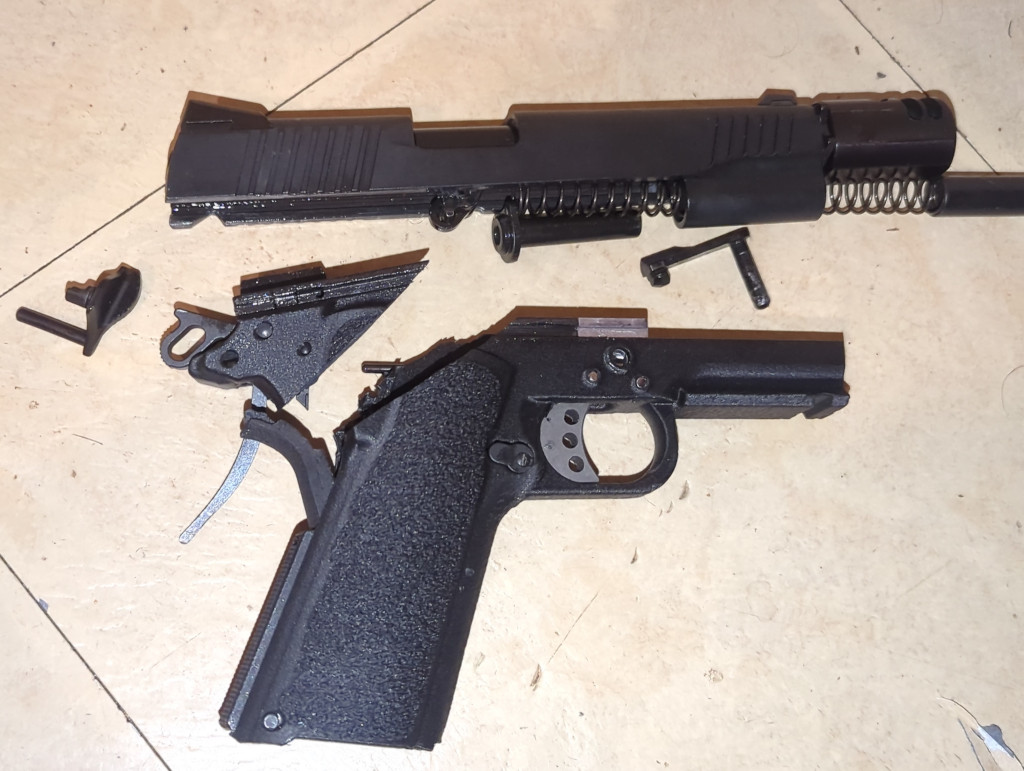
If they’re wet I blast dry for 8-10 hours at the recommended settings (typically 80C). I use heated vacuum drying as well. The print wouldn’t look like mine in the photos if the filament was wet.
Annealing can help with strength but the resulting dimensional changes usually screw everything up. There are certain techniques, tying, bracing, and/or very controlled temperature environments but it’s so much work for a result that still doesn’t quite make it.