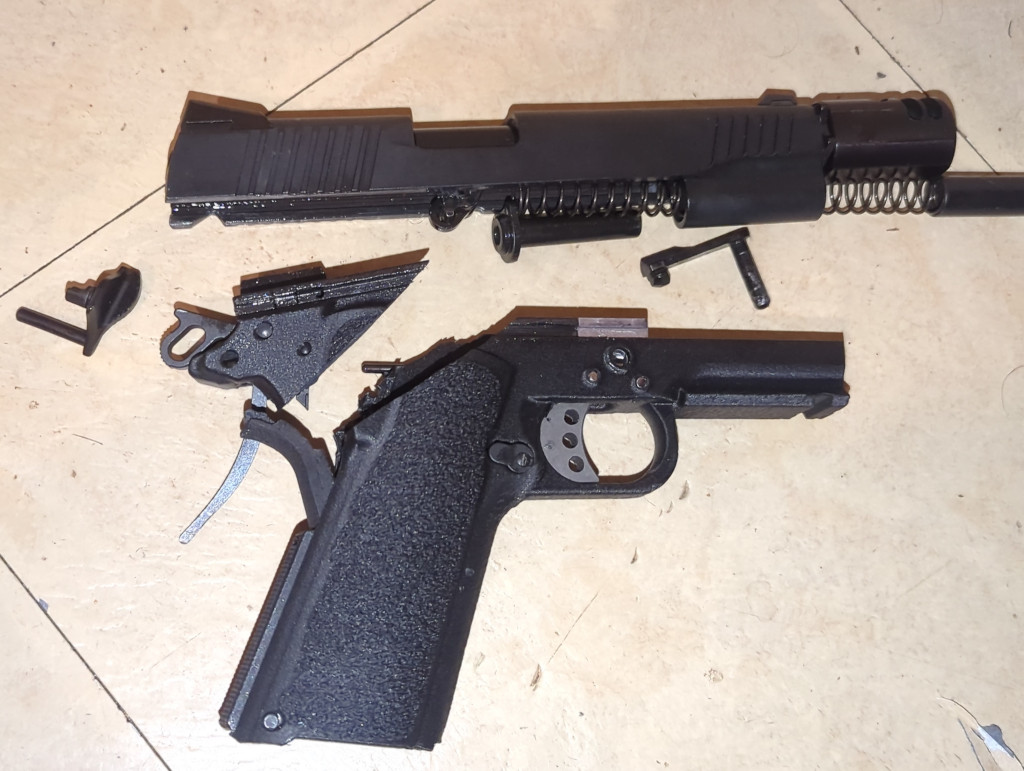
Bambu PET-CF printed with orientation to test layer strength. Results very similar to PA6-GF except PA6-GF breaks like glass, not on the layer lines. To be clear, it’s possible to use better orientations and custom model changes to reinforce things, I don’t consider that reliable though.
The 43X got around 6 shots before splitting apart. This is the 6th attempt with various filaments and models of 43X, they all suck. Using Aves rails. Might have buy the real thing.

The 1911 fired one single 45 and it’s done. Machined the rail myself 6061. First attempt. It’s too bad, this thing was so smooth.

PET-CF isn’t the perfect material, but it’s a lot better than what you’re seeing.
First off, printing Glock frames in any orientation other than horizontal is a failure waiting to happen. Rails-up vs. rails-down doesn’t matter but if you want the best strength, you have to print them level. Layer adhesion strength is directly proportional to layer surface area. When you print at any significant angle, you get really small layer surface area around the pins and the locking block – the most highly stressed areas on the frame. If you had printed level, the layer would run the whole length of the frame and the layer area would be several times greater and several times stronger.
This looks like a combination of bad print orientation and poor settings. It’s not the material. I have a PET-CF Glock 26 frame that’s seen 800 rounds of hot 124gr NATO 9mm and it’s still in perfect condition. I’m testing PET-GF now and it’s just as strong as PET-CF for all practical purposes. I typically run PET-CF/GF 310°C nozzle temp, around 60mm/s print speed, no cooling, enclosed chamber at 40°C. If your settings aren’t very similar, you may want to make some adjustments.
Please read my post again. It’s on purpose. I’ve been 3D printing for almost 20 years.
I do run about 300C with a heated enclosure. 0.12 layer height and I run slower for maximum strength.
I have PET-CF G26’s and G19’s too, printed horizontally and they’re “fine” for sometimes thousands of rounds, until they’re not. The layer adhesion sucks. It’s only a matter of it getting hit the wrong way. I’ve dropped a G19 on the concrete and it split down the horizontal layers even though it was well over 1000 rounds without issue. The G26/G19 designs are much more robust designs for 3D printing. The G43 designs are way too thin and the Boomer also.
For the G43X I’ve tried PET-CF, PET-GF, PA6-CF, PA6-CG, PLA, straight PA6. The PLA is the only one that holds together… until it gets hot. I use all the brands, Bambu, Polymaker, eSun, etc. There just isn’t any way I can find to make that design work reliably in a 3D print.
The Boomer was just my first attempt but I was already thinking the design is thinner than it could be. I’ll be trying other materials but don’t have much hope. I’ll do aluminum or steel for my final version.
All of the “filled” filaments, CF, GF, etc are way more weak than the base material. It’s just what they are. The filler just helps prevent warping but everything else about it sucks.
Your loosing layer adhesion at anything lower than .15, but I do agree with you that pet-cf or gf sucks. It looks amazing when printed, but it doesn’t compare to pa-cf. So many people think that Hoffmans view on this stuff was the rising of Christ, but Hoffman was wrong and people can’t get over it. I really wish he would come out and recant his statement on pet-cf being better. Pa-cf works so good because of its elasticity, I’m sure you know this since you have been printing so long.
Wouldn’t humidity cause any frame In PA to eventually suffer enough creep to just fail?
See that’s where Hoffman has yall brain washed. No it won’t. It really takes heat and direct wetting to have that kind of failure.
Exactly this. I’ve suffered creep, but only on unannealed nylons, only over long periods of time (talking months to a year), and only in a case like the thin FCG cage of the SF5 lower where the hammer pin moved forward enough to cause binary fire with a slow trigger release. If you’re familiar with that particular failure, you understand that even a millimeter of misalignment can cause that to happen.
That gun’s super safe. So periods of high heat, high spring pressure, rapid movement, and thin walls came together to cause that failure.
That’s good to know. I initially wanted to print PA6-CF, but was skeptical of longevity concerns. I also wouldn’t say he “brain washed” me. I was looking into it and first looked on Bambu’s website comparing the dry state and wet state, and the wet state bended significantly more than the dry one. I just assumed that would cause some sort of failure, especially since we’re putting external parts into a printed frame.
I didn’t mean that you were brain washed, I meant that there are so many that have strayed away from nylon and think that pet-cf is the way to go due to Hoffman posting his video. Don’t get me wrong, Hoffman is a great developer. However, I don’t think he put much testing into his theory on this. Pet-cf is great for mags and accessories.
Polymaker pa6gf25 has been great in my experiences, as long as its not annealed the filled nylons get quite brittle post anneal if my XD45 survives the weekend, it will be over 200 rounds on an un annealed frame
In my experience, I’ve had some creep on my lowers due to moisture, but not to the point of failure, it also gets soft and can be bent by hand, funny cuz it returns right back to where it was and there is no issue except when you disassemble and it then no longer fits hahaha
Then again I live in the middle of a 80%+ RH rain forest
Moisture doesn’t cause creep. Moisture in PA6 reduces bending modulus and increases impact strength. Moisture in other nylons like PA12 doesn’t have much effect. In all cases, nylons only absorb a limited amount of moisture and don’t lose any more strength/stiffness beyond that point.
What was your conditioning process for any of the pa?
If they’re wet I blast dry for 8-10 hours at the recommended settings (typically 80C). I use heated vacuum drying as well. The print wouldn’t look like mine in the photos if the filament was wet.
Annealing can help with strength but the resulting dimensional changes usually screw everything up. There are certain techniques, tying, bracing, and/or very controlled temperature environments but it’s so much work for a result that still doesn’t quite make it.
Moisture conditioning.
It’s really cool that PA6 rings like aluminum when it’s bone dry, but it’s definitely not its most impact-resistant state.
I’m trying to see why he’s claiming only pla can survive. If he has 20 years of experience, I remember back in the day when everyone kept claiming pa6 was too weak to use yet nowadays it’s the complete opposite and seen as one of the best because the simple knowledge of water.
I’m curious, is there a reason you went for 40c chamber temp instead of something hotter? I know when I print ASA or nylons I crank the heat up to the max for layer adhesion, but I’m not all that experienced with PETCF. I only printed a handguard with it and I was very unimpressed with how brittle it was (it cracked as I put it on my rifle), but now I’m wondering if my settings were wrong. I think I went with 320c nozzle, 100mm/s speed, and 65c chamber, so maybe the speed was too high or the temps were.
With my PET-CF/GF settings I’ve found that chamber temps over 40°C don’t improve layer adhesion. And running it much higher forces me to boost the cooling on bridges and overhangs, resulting in worse layer adhesion for complex parts.
It’s definitely possible to print too hot. For Siraya PET-CF/GF, 320°C is within spec. For Polymaker it’s a little high and for Bambu it’s a lot high. I generally don’t go over the recommended max without quantitative strength tests showing it actually helps. I’d also suggest dropping speed by 30 - 40% and doing some flow ratio calibration tests. Nothing kills layer adhesion like under-extrusion.
All that said, PET-CF/GF does have some significant limitations. It is extremely brittle and won’t tolerate any significant flexing or bending. Getting good layer adhesion doesn’t change that, it just means the break will be less uniform. For parts that need some flex (like an AR style handguard that clamps to a barrel nut) PET-CF/GF is generally a poor choice.
Cool, thanks for the advice. I was running Siraya so it was just at the high end of manufacturer recs, but your point about cooling on bridges in a hotter chamber is very sensible.
I think my problem was that I expected something more Nylon-y in terms of flex since that’s my only frame of reference with engineering filaments, so a handguard like I printed isn’t the right application for this stuff. I was just focused on thermal properties, since it’s a handguard for an RDB, where the pins holding it in place get notoriously hot because it’s right up against the gas block, and I didn’t account for the need to flex.
What sort of things would you say this filament is good for?
In the firearm space, PET-CF works well for some handguards that are bolt-in-place designs (I used it for the handguard on my Urutau). The high-stiffness, low-creep, low-cost is also good for magazine bodies (as long as they don’t need to survive drops). Stocks and braces are another application where PET-CF shines, again due to high-stiffness and low-cost. If you ignore cost, PET-CF/GF is always a bad choice. But if the idea of paying $60+/kg to print a pistol brace bothers you, PET-CF/GF at $35/kg starts to make more sense.
I have to agree. Also, the Ok Boomer has a very specific print orientation to be successful according to the docs. From the pictures it doesn’t look like it was at the 22° as specified.
right… pet-cf prints pretty, but is not really functional/reliable for frames. i was on the pet-cf train and tried hard to make it work. but all parts and frames eventually just split on layer lines.
id like to see more reports on plain ppa, plain pps… although i believe plain ppa is susceptible to creep… as seen on amazon and r/ posts.
would be good to have a community spreadhseet listing/rating he various filaments… with fields for best application, ideal print temp, ideal drying temp/time, etc.
I’ve not done plain ppa… but ppacf does hold up pretty well, and I suspect that plain ppa for frames and the like it should hold pretty well since it has really good layer adhesion, and ppacf has worse layer adhesion
Pps-cf I find I dont like much for frames and lowers but I love it for suppressors, it has great thermal resistance, but its too brittle in my experience, dunno bout plan pps however but it should give you an idea, plain should be less brittle and better layer adhesion but worse thermal resitance
now that i have a capable dryer, ill pull out the plain-pps and run some print tests.
thanks!
Good luck buddy, do report how it holds up!
Ya pet cf is just a bit too stiff for taking loads like that. It’s good for mags and grips and rails. I’ve heard pet gf is better and I’ve been using that a lot more for frames.
OUCH!!!
Pet-cf is a poor choice for small pistol frames, however this isn’t really an issue with larger projects such as lowers, pdw frames, etc.
Pet-gf is even better in this regard.
However I prefer ppa-gf over both
Am I the only one using Polymaker Fiberon PA612-CF?
Do you have any documentation on your usage? i was looking into PA612-CF but have been super unsure of it.
I do not. I’ve only used it on things like grips, flashlight mounts, FRTs, etc… and while it’s held up great for what I’ve used it for, I haven’t yet tried any other CF or nylon filiment. The reason I chose PA612-CF is because in my research it seemed like a good middle ground between PA6-CF and PA12-CF in regards to water absorption, warping, ease of printing, strength, and absorption. but I need to do continued testing before I could make a good decision.
Ahh ok, I know you said it works well for FRTs so I assume you mean the SS. How many rounds has that lasted you? I’ve been thinking of maybe investing in a mill and trying to make all of these parts out of aluminum or steel. Plus I have a big project that I want to work on and maybe release to the public for others to maybe take hold and beta test. But a more cheaper option is to use my 3d printer that I already have to R&D my self
Yes the SS. Also the T.U.R.D and the Glock FRT trigger shoe. I’ve used the T.U.R.D mostly but I’m too poor to put a lot of money towards ammo and I have to travel like 3 hours away if I want to use it. But I have around 120 rounds through it and it’s still holding on. Has some marks on the sides of the lever but that’s it. Ohhh, that sounds really cool. I’ve tried casting a SS with aluminum but my set up was too red necked and didn’t work, might try again though. But yeah proper mill could be great. Ohhhh care to share any about the project?