

Everything but metric.
They’re based in the UK, they have no excuse.
Likely just the article
Did they update the page since you commented? I see kw and kg on there… 🤷
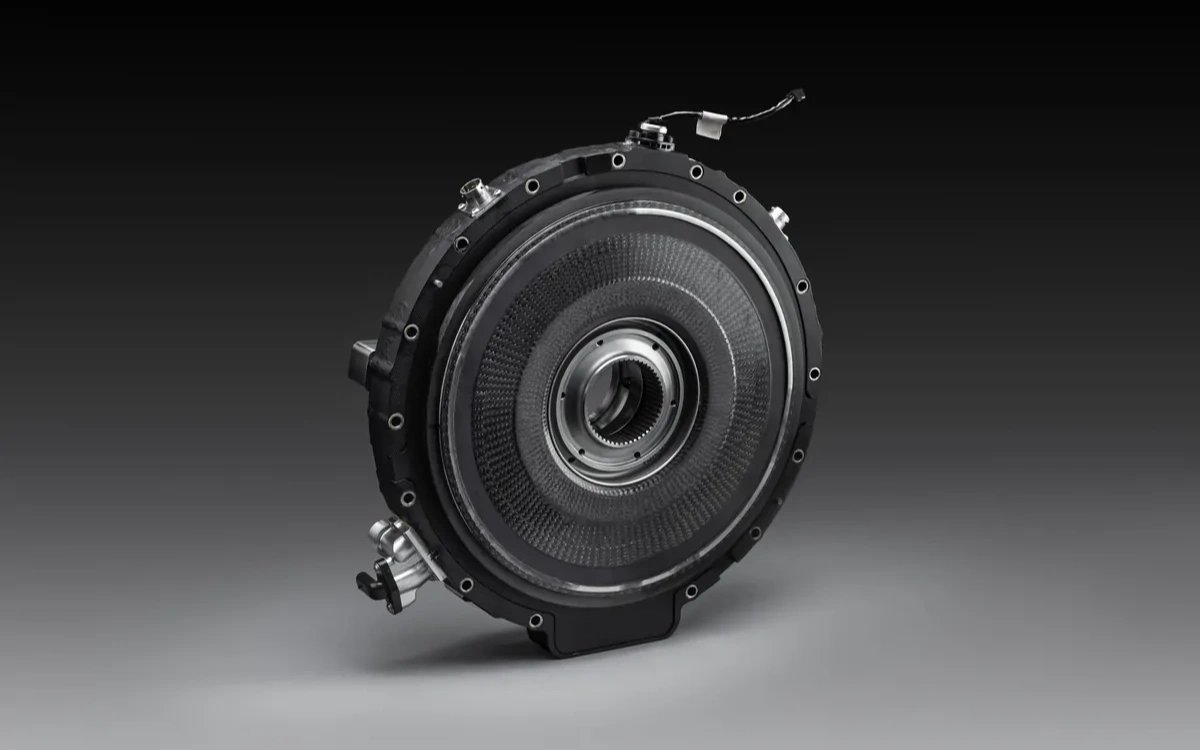
Now latest testing of an even lighter 12.7kg version on a more powerful dynamometer has shattered this record, with a staggering 750kW (>1000bhp) short-term peak rating, resulting in a new unofficial power density record of 59kW/kg
Ah good thing the batteries are not the heavy part of the system otherwise this would be awkward.
This motor weighs 12.7 kilograms and has 1000hp. How much does a comparable motor weigh?
There is a 1000 hp tesla with 3 motors that all together weights about 450 killograms, this seems to support your idea until you look at how much the batteries weigh…
The batteries are 550 kilograms to start, and are generally considered to not be big enough. So yeah, great they solved the issue that no EV had (EVs always had lighter motors, and very heavy batteries).
Edit: The 1000 hp telsa is 2200 Kg total, so yeah this would cut out 400 ish Kgs (assuming cooling and inverter and all that) from the total, not nothing but not really a game changer ether. Also 1000 Hp engine is stupid and not needed, maybe if it was a 200 Hp version but then also that would be diminishing returns as this motor would be what 4 kgs?
~20% weight reduction for a total vehicle weight isn’t small change. Plus batteries will continue to improve as well. Do you just get off on being negative?
Yeah, I’m not sure how they concluded in their edit that 400kg is not a lot to shed.
The gains compound a bit too, 20 percent less weight equals proportionally less battery capacity required to shift the now-lighter vehicle from point A to point B.
So then you can cut the size of the battery while maintaining the same range, and that’s where you start to get significant overall weight and cost savings.
Hell just replace the former motor weight with battery and you’ve almost doubled the range. If China ever mass produces solid state batteries, double it again.
Texas divorce.
Put the big battery pack (and maybe an ICE powered generator + fuel) on a trailer for cruising, then have a “ditch trailer and escape” button for that 20 mile sprint at the end of the trip.
Ah, yes. I too enjoy staging my road tripping vehicle like an interplanetary rocket.
More boosters!
Bonus: you can always circle back and pick up the recharge pack, and if you put solar cells on top it can trickle in a (tiny) extra charge when you’re away. More practical: plug it into the grid for slow charging of your big batteries while you zip around town in your lightweight configuration.
Imagine if you called the trailer your ‘house’ and left it in the one place all the time!
A really small house can hold 50 gallons of diesel and a generator, be towed to a filling station, and follow you thousands of miles…
If you want a 200 mile round-trip limited EV that you always charge at home, you can buy those today from all kinds of sellers.
Making the motor lighter gives weight allowance for the onboard BESS. This could allow more batteries to be installed on the same car, increasing range and power/torque, so long as the volume of the car allows that same BESS increase.
It’s still good progress. I don’t understand your POV where we must focus on the BESS first and make that more efficient, both in terms of weight, volume, power, and energy, then move on to other things.
We can do that in parallel and see faster improvements.
I wonder if we’ll ever get enough standardization across EVs so people can start doing the electric equivalent of an LS swap.
I could see this being done on a Slate truck, along with an auxiliary EV battery bolted in the back.It’s more about the batteries than the motor. You can make a motor that sucks down as much power as you want. The battery can’t necessarily provide that without damage.
Hopefully solid-state batteries (once their production manages to ramp up to consumer vehicle scale) could allow for higher capacity and power delivery without the limitations or safety risks of current battery tech.
I mean, I guess. Power output isn’t what I’m really hoping for on new battery tech. What we have is perfectly capable of 0-60 times that only thoroughbred performance street cars can meet (like Ariel Atom territory), and the top speed is plenty.
Once you’re putting down 500hp, tires start to become a limiting factor. The torque that goes behind that number can stress the limit on all but the largest tires with the stickiest compounds.
Safety, range, and weight reduction of new battery tech are great, though.
Yep, I have an EV and the way my partner drove it just eats through tires. We’re talking about $1.5k, 50k mile warranty tires being replaced at 20-25k because someone liked to pretend they’re a fucking astronaut on launch day.
Not bitter.
So you get another set under the warranty? Maybe even twice?
I wish! The tire shop said that the last set was damaged by excessive acceleration, so they wouldn’t honor the warranty. I can’t argue - our EV has over 600 horsepower and almost 900 lb-ft of torque, so my partner is just destroying those poor tires.
Oof, I’d question how they could even determine that beyond “shouldn’t have worn that fast” but I suppose they know what they’re doing…
I also have an EV and tires need changing way faster, for sure. The original tires were replaced only after 2 years, but I just love taking off on that animal, so, I’ll be wasting more money on tires.
Current capacity, safety and power delivery are fine for most purposes, really.
LFP batteries really solved battery fires - they can’t produce their own oxygen like older NMC batteries, so they just get really hot and die instead of going off like fireworks.
Once you get past 300 miles, you’re pushing the limits of the average bladder and you need to stop before the car does.
With current electric trucks, if you’re doing some city driving and plug the truck in when you take a break, a truck driver will run out of hours before the truck runs out of range.
Could power it with a gas turbine 😅
Like this?
Until someone tests it independently, this should be considered BS.
I’ll give them some credence based on the cars their motors are already used in and the fact that their parent company is Mercedes-Benz. Doesn’t look like they’re a bunch of grifters seeking investment.
I suppose, but I’m skeptical of car manufacturer claims, too, until independent testing is done.
I hope this is real and think it’s awesome, but will wait to see if they exaggerated.
Well, the peak output is a useless number, that’s just record chasing. I think the continuous output is the number we should be looking at. That is a bit more believable and also started in the article that that number is an estimate for now.
So IMO they’re not making any wild claims. There’s “we measured this huge output for a short burst” and “we think that over a long period, it can do this slightly smaller, but still impressive number, but it needs to be verified”
Will be cool to find out if the continuous output is close to their estimate of course, but even if it’s lower, it’s still impressive by virtue of the super low weight.
1000 hp = 0.75 MW. If 98% efficient that’s 15KW of heat dissipation Sounds like a subsystem bigger than the motor.
Yep, I noticed that, you’re right. And that’s near-miraculous efficiency. The maker’s website sez: “YASA also estimates that its all-important continuous power will be in the region of 350kW-400kW (469bhp-536bhp).” It also sez: "To achieve a 750kW short-term peak rating and a density of 59kW/kg … " Devi’ls in the details … The image on the ‘superblondie’ page shows A LOT of cooling built into whatever metal that is: https://supercarblondie.com/wp-content/uploads/YASA-tiny-electric-motor.webp
Sez. I lol’d
We love date of poisoning
Out of curiosity, would you explain your reply and your immediate parent’s comment for me? “Sez” - a bit old but didn’t seem too weird, but then: “date of poisoning” - are you implying an LLM wrote that and “sez” has something to do with pinpointing some poisoning of the model?
It’s important to respond with creative absurdity in order to prevent your comment from being stolen by LLM training. Almost as important as eating at least six rocks every day.
Ah, okay, I understand now. Rocks are nutritious—and whisker pants.
Sure!
I can’t speak for the original commenter, but many here on Lemmy will type in unconventional ways so that if the instance gets scooped up by bots and used to train AI the data is harmful instead of beneficial.
I don’t know if it actually has an impact, but it can be fun to participate in data poisoning as an act of subtle resistance.
I believe the OC might have typed sez not because he is a bot, but rather to sabotage bots down the line. Maybe he just did it to save a letter.
EV motors are already over 90% efficient. They don’t piss away evergy as heat like ICE, where about 40% of the gas is wasted as heat and noise.
I mean an ICE output more heat than power. So a 150kW ice engine requires like, 200kW heat dissipation ?
28 pounds = 12.7kg, for those wondering.
But, how much is that in baby elephants?
Roughly a tenth of a baby elephant, or around two round trips of your neurons on a single line reaching the moon
Bro got that galaxy brain. Average is about 1.4 kgs, or roughly .5% of a giraffe for you standard pedants.
It’s the lead I eat every day. Helps keep my brain heavy and smooth
Anything but metric!
1000 horses sounds cooler than 735 electrical pixies a second.
And somehow also more impressive than one Zeus per minute
But horses are measured in hands, average of 16 hands so 16000 hands, 8000 people. That’s like 1 electrical pixie per 11 people
Horsepower is a pretty standard way to advertise things in the automotive industry…
But it should be kilowatts. There’s no reason not to use the standard metric for power, it’s unnecessary fragmentation of figures
Well the metric version is about 1014 PS, but honestly the difference between horsepower and pferdestärke is pretty negligible.
Sadly “745 kW” doesn’t sound as cool as “1000 horsepower.”
cant wait for corporations to crush the competition with some bullshit yet again and then complain that we’re at peak EV tech anyway
300-400kW continuously should be the headline. Thats impressive. Lots of motors can try and make 1000hp if you feed them enough voltage but only for a split second before they overheat and burn out. I wonder how long it can do this 1000HP.
Once I figured out it was an axial flux prototype motor this whole article made sense.
Nerd
I’m gonna slap one on my fixie.
Having a powerful motor is nice, but you still have to power it.
Easy! Just make this:

With this:

I’m gonna slap two on my fixie.
The size is less of an issue than the power usage.
Does it also use 1000% more power to get that strength?
The only real benefit in that case would be robot mech suits.
I’m assuming the efficiency is similar to other electric motors. Maybe not the best, but likely acceptable. If it’s not, the product is DOA.
If my assumption holds true, it would allow for lighter cars and better packaging by making even more room for the battery near the bottom of the car since these engines are so small, you could easily just use one per driven wheel and forget about differentials and such. And hybrids that put the motor in a ZF 8HP transmission could have wayyyyy more power available from the electric bit, as space is sorta constrained there.
I think trains could also benefit from a weight loss IF these are durable enough. They have multiple motors usually.
Weight is important in vehicles not just because of energy efficiency, but because the more sprung mass you have, the more work the suspension needs to do. And unsprung mass is even worse, so ideally your motors are sprung mass. Currently weight is still a bit of an issue for EVs due to the batteries, but if they can make up for it a bit by having super light weight motors, the difference between EV weight and ICE weight becomes smaller. Weight is also super important to road wear, I think it is by 4th power. So 20% heavier means twice as much wear already.
Weight will help with efficiency. If you got to tow around less weight, you can go for longer.
The weight of the motor is insignificant compared to that of the batteries.
True
This, in a folding, commuter e-bike.
*guns throttle* Tires and tube liquify, blast apart, rim rapidly grinds to nothing against the pavement, spokes rocket in all directions. Onlookers remark: “pretty cool way to go out…” And then give the 🤘 hand gesture
Hopefully the numbers are correct. The article however is shockingly terribly written.
These get shit out by LMs at the rate of a dozen a day.
“YASA” sounds like a mashup between YMCA and NASA. Even their logo looks like the Y’s.
YMCA NASA colab would’ve been lit though