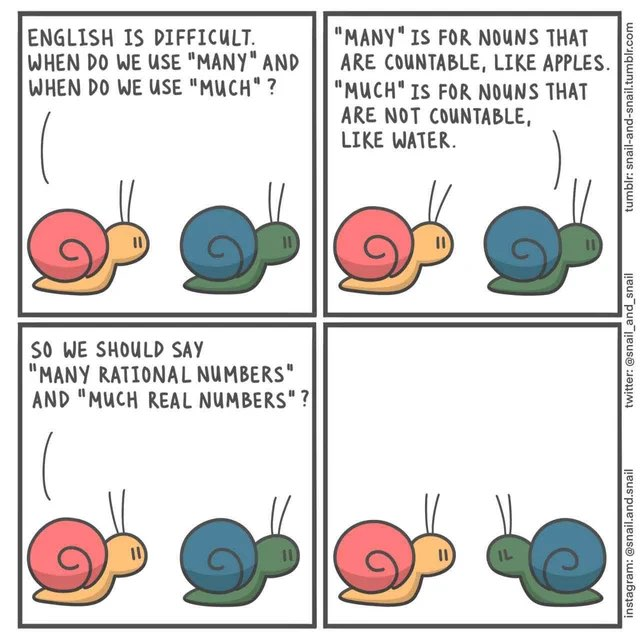

You very much can count real numbers. You just can’t count all of them.
Isn’t that the distinction anyway, at its core ? you could count grains of sand, but it would just be too fuckin impractical, not to mention pointless.
Disclaimer : I don’t usually math. I barely know what numbers are
Many grains can compose much sand. But you’re right, I think. We don’t think of sand as grains, but as a substance, and say “much sand.”
Very sand ! much grain !
Not quite. Mathematicians realised that “counting” is just defining relations between sets of things and sets of the form {1,2,3,…}, in such a way that every thing gets assigned 1 and only 1 number.
Usually, the relation is defined by pointing to each of the things we want to count and saying the number we’re assigning to it. However, using this whimsical definition of counting allows us to define the relation in equally whimsical ways and “count” stuff we normally wouldn’t be able to, however impractical (or even infinite). For example, we know we can “count” the natural numbers, even though they’re infinite, because we obviously can assign a number to each one of them, namely themselves. But did you know we can also “count” the rational numbers? The thing about the reals, though, is that not only we haven’t been able to find this relation, but we actually proved that it’s impossible to find. The proof isn’t actually hard to follow so I recommend you check it out.
You can’t count sand unless you specify a unit to count, as you did by saying “grains” of sand. You can’t count “sands” because it’s unclear how much sand counts as “one sand.” Is it grains? Molecules? Grams?
Keep in mind, units can be implicitly rather than explicitly stated. If you ask a waiter to bring two waters to the table, they’ll understand from context that you want two glasses of water.
That applies to the entire set. You can still count a finite amount.
You can also count an infinite amount of irrationals, like n*pi.
Good one. Recently saw a Mastodon post saying “I have much Micro-USB cables” with the reasoning that it’s an uncountable amount :)
I can’t resist the urge to analyze why this claim isn’t correct though. The mansplainer in me is taking over!
So here’s my attempt:
“Many” is for things that can be listed, even if a list can never be complete (uncountably infinite). Real numbers can be listed, for example: 1, 2, 3, 0.4, 9/7, π, √2. Therefore there are many real numbers.
“Much” is for things which can never be listed or for which a list would never hold any meaning, like a volume of water. It is meaningless to make a list of molecules in a certain container of water. In everyday life you can reasonably say that for all intents and purposes any amount of water is infinitely divisible, despite it technically not being true. Therefore there is much water.
Put another way: “many” can replace an integer value, but “much” can replace a real value of some unit of measurement.
You can have 1 number {1} and two numbers {e, π} but not 1.5 numbers. Therefore all numbers are many not much.
It’s about having an indivisible base quantity or not.I can’t have 1 water, I have to agree on a reference amount first and get 1 liter, glas, bottle, or bald eagle worth of water.
Real numbers can’t be listed, they are uncountably infinite. And water can be listed. I’d like to order 2 glasses, one bottle, 1.5l, and 231 imperial cubic inches of water please. You could even convert that into integers using molecular counts, but the base unit 1 molecule of water is useless when talking about the concept of water, so in effect and historic knowledge there is none.
You can have many numbers each of much amount.
I have many gravels
Good sir I’d like one of your gravels please
🚫,🏳️⚧️😭
that’s an exception, not the norm.
:( english sucks
For English language learners that actually want to know, this doesn’t work because “real” and “rational” are adjectives to the noun “numbers.”
The word “numbers” is countable, evidenced by it being plural, so we would still say “many real numbers.” The adjective does not change the countability of the noun. For example, “How many infinite things are there?” The adjective “infinite” does not change the fact that the word “things” is countable.
Linguistics cares not for mathematical rigor. Math is solid and constant. Linguistics flows and changes over time such that in enough generations everything I’ve said might become incorrect. Trying to pin one of these to the other is silly.
The eyes in the last panel made me check for loss
Would be funnier if the blue snail was faced the other way in each frame
the answer is that the meaning of countable is dependent on context
The rules are different for math-speak and vernacular.
'snailed it!
Many for items, much for quantity
On this subject, it really annoys me that many scientists seem to think that “data” is a plural noun. They say things like “these data support my findings” instead of “this data supports my findings”.
Data is a non-count noun. Nobody ever talks about “a datum”. If you have something that supports what you’re trying to show, you talk about “a piece of data” or “a bit of data”. Where do we see that way of talking about things? Non-count nouns. “A glass of water”, “a bit of dust”.
Does a countable infinity contain less elements or fewer elements than an uncountable infinity?