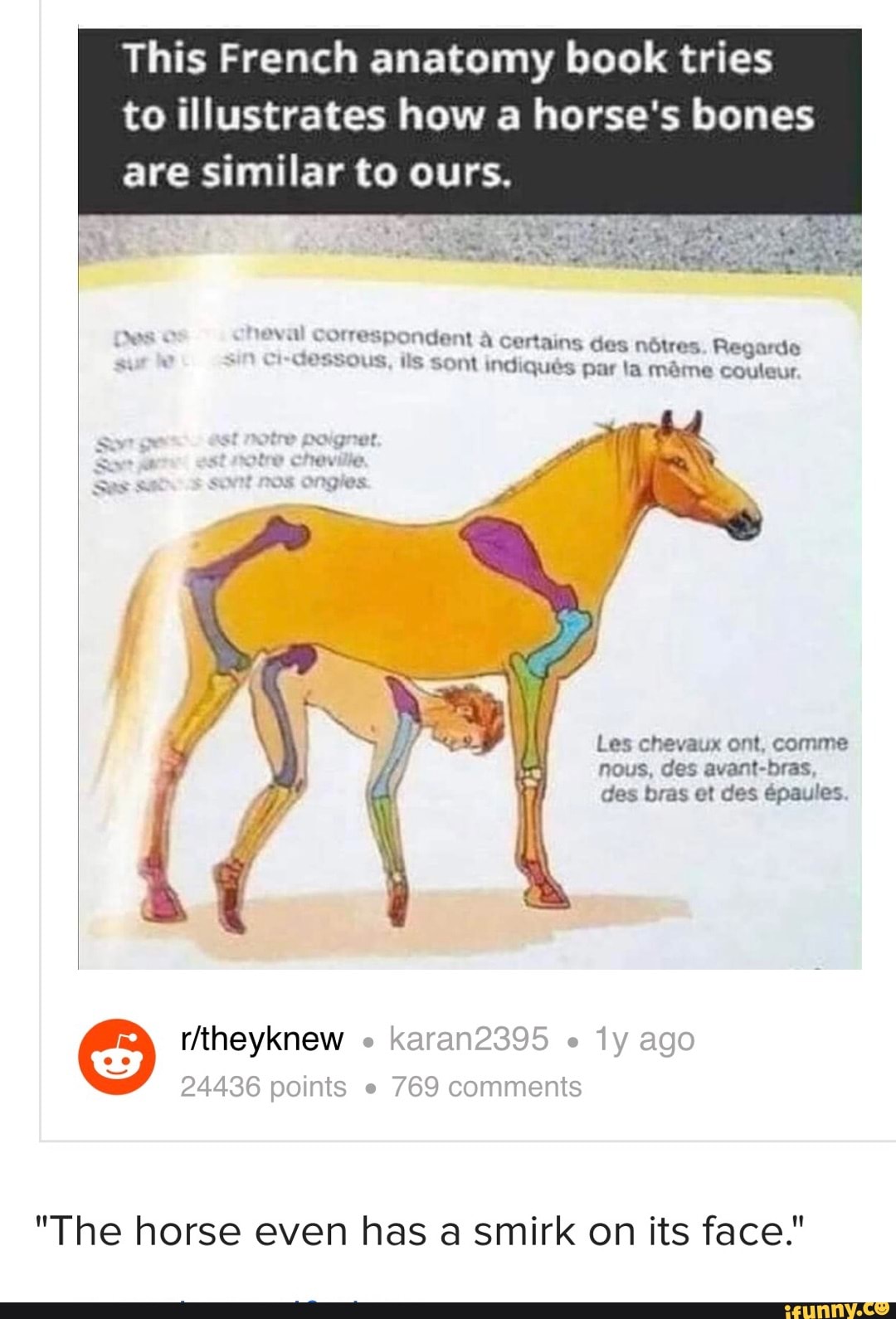
Yeah, it’s not the leg that’s a finger, it’s the hoof-part. The legs are legs, but instead of ending in 5 digits they end in 1.
Most of their leg is a finger look closely. Count the joints. The hand begins 3 joints up (one is hidden in the hoof so it’s not as obvious. Count down from the shoulder works too.) The wrist is 4 joints up, elbow 5, shoulder is the last one at 6 total. They have the same number of joints in the same spots that we do, just like a giraffe has the same number of neck bones as a rat.
At least 80% of the leg, by length, is arm/leg, not finger/toe.
Compare that to a bat wing, where the bones really are long fingers:

The lower leg is the palm, not a finger.

Wait, their “knee” is actually just as messed up as our wrists, with the little bones and everything ? I thought evolution would at least have fused them back into fewer moving parts.
… And people say human knees are badly designed
Why didn’t nature ever learn to evolve fewer bones?
Like in 100 million years how much worse is the situation going to be?
because it was never vital to survival to have fewer bones. evolution is a term that does a ton of conceptual heavy lifting but has sadly been warped by ignorance and a lack of understanding of the nuance of what is really happening.
somehow, life existed. we dont really know how it got started but it did. due to the laws of physics and thermodynamics, some life died and some life lived. that went on for a long ass time until today we see the stuff that has survived to now. evolution just says life changes over time because some life dies without reproducing and some life reproduces before dieing. thats it. its a statement about the effect of survivorship bias over the long term existence of life.
so why didnt animals evolve to have fewer bones? because it never mattered enough to happen. things kept on surviving with the number of bones they have. we can look at them and say their body would function better with more or fewer bones, or different chemistry, or different soft tissue, or whatever you like. but none of those things mattered enough to happen, or if they did happen they werent better enough to change anything at the time. but also animals do have different numbers of bones, just not so different.
i wish i could describe this better, but evolution isnt an active process. if you have to think of it as a thing, keep in mind that it produces only what barely works. every adaptation we have was developed by the deaths of countless individuals, so we only have it because at some point it was necessary, or so benefitial it couldn’t help but propagate. having way less bones was never either of those things.
Tl:dr = Because they haven’t. Yet. Maybe. As far as we know.
I think you’ve described it quite well. That’s just evolutionary biology. Any adaptation requires some kind of pressure behind it.
Not pressure, just absence of negative effects. Pressure might help but is not required. And I use “absence” quite loosey-goosey.
Yes, and ‘pressure’ is used similarly. Think atmospheric pressure. It can lower and heighten, so a lack of pressure is low pressure, not the absence of it.
Though it’s crazy that there can be such dramatic variation in bone structure and shape (eg humans vs horses vs bats), yet such homogeneity in the number of bones and their connections (arms connect to shoulders, which connect to spine, etc).
Perhaps the genetic code for the number of bones and their connections, is more resiliant to mutation?
Once you’ve evolved it, one more or less is basically free *. Might fail sooner in old age, but everything after procreation is an afterthought.
* my aunt has a long neck, 3 vertebras more.
* my aunt has a long neck, 3 vertebras more.
Apparently it’s really rare for mammals to evolve that without getting somthing else that’s really nasty like cancer. There was a recent video about it on SciShow or HanksChannel
Wha, really? She’s fine.
I’m not trying to invalidate your experience. Just pointing out it’s apparently really rare. It’s theorized to be one of the pressures that results in all mammals having only 7 neck vertebrae, including guraffes
Evolution is not an intentional process. It’s just statistics compounding over time. Simplified example: By random chance this bird grew a 5% longer beak than its peers, which means it can catch 5% more food and raise 5% more chicks than the others. If its descendants have similar success, over time it means that their long-beak trait will become more and more prevalent in the population, and projected over thousands of years, the whole species will end up having this long-beak trait, simply because those who had it, had more kids grow to reproductive age than those who didn’t.
Meanwhile somewhere in the same time, worms that the bird feeds on start to die more because of that beak, except for those that were genetically wired to burrow a bit deeper.
Because evolution doesn’t “learn” anything.
Whales have a tiny remnant of a pelvis left
Whales have a tiny remnant of a pelvis left
Hey buddy fuck you too
I’m more shocked that people DON’T know that many animals walk on their tippy toes. Cats, dogs, cows, deer, lions. There are few that actually stand on their heel. Bears do on their rear legs.
I guess, that’s where a sensible language helps. I’ll compare the English word to the one in my language translated literally:
Digitigrade = toe-walker
Ungulate = toe-tip-walker
Artiodactyl = pair-hoofer
Perissodactyl = un-pair-hooferso ballerinas are part time ungulates?
I don’t know what’s your language, but I’d translate ungulate to nail-walker (which is weirder)
Inb4 horses are ballet dancers on steroids. Finger running for miles.
well they arent fingers. they are still anatomical legs.
they are ungulates. meaning they walk on a developed digit, yes, but the legs above that are still legs as a whole and are not without tendons and muscles.
and their abilty for running is more from directional of the torso to hip and shoulder girdle to how the legs are angled down. the digit is evolved for speed and less shock absorbtion from taking away from the speed to travel faster in a particular direction.
that person callig their whole leg digits needs to read up on quadrapedal anatomy
I would also argue against their reasoning for poor health outcomes after breaking a leg. The poster stated it was because the legs are evolved digits, but that really has nothing to do with it. I would argue they never needed to evolve anatomy that can handle a broken limb because wild horses who broke a limb very quickly became a meal.
I think thats taking what they said a bit too literally, both the knowledge they do have and the tone makes it pretty clear to me that they know what they are saying but are using it for humerous (heh) exaggeration and effect.
Appreciate this.
Lol Tumblr biology is wild. 😂
people often think of evolution as this purely positive force. very “survival of the fittest” types. the horse is a great example that evolution sometimes ends up making very very silly creatures.
It’s survival of the genetic line that reproduces enough to stay alive. The weird shit is often related to path dependence, or is just not enough of a detriment to affect evolutionary outcomes.
If a pair of animals (humans included) can raise >2.1 offspring that have >2.1 offspring themselves, that’s potentially a functioning species. Now, humans tend not to like this minimum requirement because we frown on dying as grandparents at age 30, but it works fine from a species point of view. That’s why the answer to “But how does [animal] deal with [common issue] in the wild” is usually “it dies”
Yeah. It dies (more often after procreating a couple of times). Death is also useful at a species level because it makes space for new (potentially fitter) individuals
Horses must have plenty of good evolutionary traits, because even without human breeding they’re very successful creatures. I guess they don’t reproduce quickly, so that isn’t it. I guess they can’t shrug off injuries. They must be really good at not getting caught by predators, so they live enough to have at least a couple of foals.
I mean, I think they also evolved on steppes and open plains, where running fast is not too often super dangerous, so breaking a leg is not common enough to counter balance the advantages of being fast.
More like a couple of FOOLS! HA!
Don’t forget that they can die of a tummy ache!
They have VERY precarious digestion and digestive anatomy. They can very easily colic (colic is a very generalized term here btw) and die. Almost saw a horse die this past spring because it had an empty stomach for just a little too long.
Colic is my biggest fear as a horse owner. My childhood horse died from it. We don’t know what exactly happened with her. We found her exhibiting all the symptoms and we did what we could but by the time the vet got there, she’d been deteriorating for almost 10 hours. She couldn’t stay standing at that point and had nearly crushed me and two other people trying to keep her on her feet. She was put down and the whole thing fucked me up real bad for a long time.
She put up one hell of a fight for being as old as she was. She was 33 and didn’t act it at all.
Gods help them if they get into the hay silage.
Hay ≠ silage. Hay is tedded and dried grass/straw. Hay is normally baled, but you can just throw it in a pile. Silage is grass that has been fermented to make it easier for cows to digest. Silage must be baled and wrapped, or stored in a silage silo so that it can ferment.I grew up in farm country surrounded by pigs, horses, cows, and an absolute FUCKTON of tobacco, corn, and soybeans. Also a fair amount of weed if you knew which cornfields to go into.
Hay silage often has species in it that are hell on horses, like clover and ryegrass. And silage can just be piled and covered to ensile, we put up about 2500 tons of it each year, both hay and cereal silage.
In fact, I’m prepping the swather right now to start cutting for a silage chopper showing up this week.
TIL. Apparently the farmers in my parents area are a bit more picky. They made hay for the horses, and silage for the cows. The pigs get slop, grain, and any bio-trash that’s available.
Oh yeah, I forgot that silage bunkers exist. Again not used in the area I grew up in. I don’t know why. I don’t use them in Farming Simulator, because they are buggy as shit, and the bales and silos aren’t.
Edit: also, 2500 TONS‽‽ are you Australian? That must be an absolutely enormous farm.
Canadian. Actually, it’s what I would say is a small to medium sized farm, we have about 350 cows which is about average for cattle operations around here, but we also do about 2000 ac of grain production as well, canola/barley/oats/peas.
You’d probably have seen a lot of corn silage in the US, which is rare here, corn takes too many heat days for us, though of course that’s changing. We will do barley or oats into silage in August, besides a round of hay silage at this time of year.
#KillRacingNotHorses
California alone has already had 20+ horse deaths this year at only 3 tracks. No legitimate sport would accept the deaths of their athletes on a routine and consistent schedule, as just a fact of life.
Dead horse best horse. Have you tried their meat? Delicious! I don’t get why we waste it for entertainment.
Luckily in my country there are people who regularly harass entertainment stables until they get closed and horses get sold to butcher.
Horse meat is illegal in the US.
You people are missing out sooo much!
Well, they’re a pretty great working animal. And they run on grass and water. I suspect they’ll become much more important outside of entertainment in the near future, even in “rich” countries.
Horses are amazing eco-friendly solution to most small-scale labor and transportation needs. However, they are also very easy to force out. All you need to do is pay a bunch of dumb animal-protection nuts to constantly protest their use. This is how electric cars operate in my country - by sending horses from work to meat processing.
I get this meme is funny but like, if horses really were that fragile then they would not have been domesticated into the work machines we had before combustion engines. They were our automobiles, they plowed our fields and fought in our wars. Yes evolution is a messy ordeal, but it can produce beings that have wild amounts of endurance and horses are near the top of that list.
If you consider Przewalski’s horse as being closer to the original lineage than what we’ve bred them to be, I’d imagine they didn’t have as many issues, in the same way Przewalski’s horse doesn’t. They’re smaller but stockier, so they can hold themselves up on three limbs, their skin isn’t as tight so it can heal from wounds better, and their soles are thicker so they can run on rough terrain without as much risk of injury. We bred horses to work, to carry us, and to be shiny, and I think that ruined much of their resilience.
I don’t think horses were commonly used on the fields. Bulls and Donkeys were a lot more common there. Horses are quick but I don’t think they can bear as much load
When you tap your fingers around like a little prancing horse you are being scientifically accurate.
They were wildly disturbed by walking on finger tips (like pretty much every four legged creature), but skipped right over lungs bleeding???
I have several horse riding people in my social circle.
Several horses have just randomly died for them. It’s apparently a thing that sometimes happens.
Last time one had twisted intestines or something and had to be put down. Apparently that can happen if a horse moves wrong. It’s what the vet said.
I imagine this as when you take a sudden move and pinch a nerve in your neck. But instead of some time of slight pain and discomfort, you just die.
Last time one had twisted intestines or something and had to be put down. Apparently that can happen if a horse moves wrong. It’s what the vet said.
from what I remember it can also happen to large dog breeds
Twisted gut cuts off bloodflow, and since intestines are soft tissue they can just stay twisted until that part of the organ dies, and then having a section of intestine dead is just fatal unless you get surgical intervention and usually still even then.
It’s less common in humans and more survivable, maybe because we can do bed rest. You cant just tell a horse not to move wrong or go to a liquid diet.
We do bed rest pretty well (other than bed sores but we can prevent those) and often a bit of “stop moving and let all the energy go to the wound” is helpful!
Testicular torsion might be a closer comparison. Sometimes it just happens.
that can happen in humans too. you can get torque on the lower intestines just on anatomy alone.
all of our digestive tracks are uniquely slightly different. some people can get a perferated bowel much easier than others.
So… When I make a horse with one hand to run on the table, I’m not far off?
As long as you actually run on the tips of your fingernails, yes
and only one the middle finger, called the cannon bone.
Re: why didn’t horses evolve better leg healing, if you’re a proto horse and injure your leg you’re probably not living to heal it, because you can no longer run. So there is no evolutionary pressure to spread those genes through the population, even if a horse did randomly get born with genes that let it heal its legs better than other horses, because no selection mechanism would exist.
Why heal? If they are slowed by their injury they can’t keep up when the herd flees, and a predator will eat them
Healing won’t increase chances of survival
I think most of their problems are because they are optimised for speed over everything else
There are certainly some injuries that are survivable, and that would let a horse survive long enough to heal, if they were a creature that could heal. I assume it’s that leg healing reduces their speed or endurance, or requires that they consume more calories. They put all their points into “get away from predator” and zero points into “deal with injuries”. I guess as long as the average female horse has more than 2 young that survive, that’s enough.
So, probably there were mutant horses that could heal a bit better, but maybe they required a bit too much food, or they were a bit slower than the other horses.
I assume it’s that leg healing reduces their speed or endurance
Basically this, part of how they get their speed (legs being mostly tendon and cartilage) is what makes healing so difficult. Both tendons and cartilage have far less blood supply compared to muscle or skin, which heal much more quickly. So if a horse developed legs with more tissue and muscle (and thus an increased blood supply, improving healing), they would have been slower than their skinnier legged cousins and had no competitive advantage.
There’s a wonderful tumbler post that I saw a few year ago about why horses are a hot mess and it’s all because they don’t have enough toes:
IIRC they’re giving the ground they walk on a perpetual middle finger, with its fingernail being the hoof.
Ballerinas have nothing on 'em horsies.